
Building Value: How Swinerton Helps Healthcare Clients Manage Cost and Complexity
Project construction costs are an ongoing concern for healthcare systems nationwide. Owners are increasing their reliance on general contractors and design teams for innovative solutions to mitigate cost and schedule volatility. As a national leader in healthcare construction, Swinerton helps clients navigate cost and complexity across a wide range of healthcare facilities.
In today’s healthcare construction landscape, large scale hospital projects can often take up to nine years from initial kickoff to final completion. This extended timeline makes accurate cost forecasting and cost control a significant challenge. For both owners and builders, this uncertainty can be financially daunting. With annual escalation compounding over time, total project cost increases can mean additional millions in the total budget—sometimes enough to jeopardize the entire endeavor.
Escalating Cost and Shrinking Margins
The reality is clear: hospitals today are far more expensive to build than they were a decade ago. According to the October 2025 issue of Health Facilities Management, since 2020 average costs per square foot have increased between 2.09% and 6.22% per year, with a slight decline in the first half of 2025. Most healthcare clients understand this shift. However, budgets are set years before a project is completed, often forcing programming or scope reconsiderations such as pausing buildout of some floors or even cutting entire floors from the original plan just to stay within budget.
Meanwhile, major healthcare networks across the country are under immense pressure to expand quickly and capture market share, not just for patients, but also for top-tier medical talent. This urgency to grow while managing rising costs and shrinking margins means healthcare systems must move fast. And so must general contractors.
Why Long-Term Planning Matters
While many clients come to the table with a clear vision and strong strategic intent, long-term healthcare capital cost planning is often less defined. The design phase alone can take a year or more, followed by lengthy permitting processes. By the time construction begins, the financial landscape may have shifted dramatically. Factors like tariffs and global supply chain disruptions only add to unpredictability.
Federal funding uncertainty—particularly around Medicare and Medicaid—adds another layer of complexity. Public healthcare clients are especially vulnerable, often pulling back toward year-end due to unclear reimbursement pathways. These funding mechanisms directly impact revenue streams and, by extension, the feasibility of future capital projects. Faced with these pressures, clients may preemptively reduce scope or delay projects altogether.
Swinerton’s Approach: Precision and Accountability
At Swinerton, we recognize these challenges and have developed tools and strategies to help our clients navigate them.
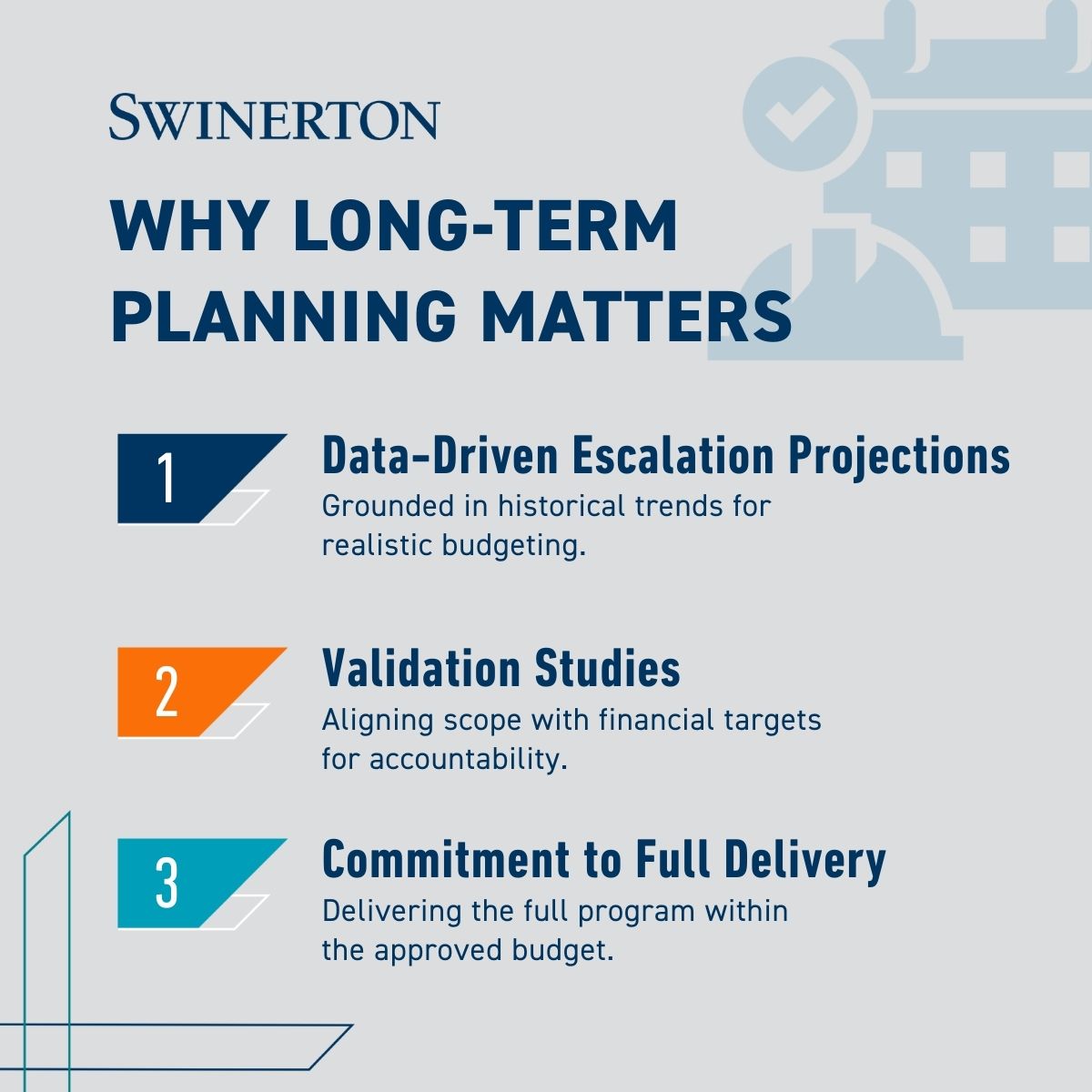
- Data-Driven Escalation Projections: Grounded in historical data from similar projects, allowing us to provide realistic budgeting guidance.
- Validation Studies: Aligning program scope with financial targets ensures accountability once budgets are approved.
- Commitment to Full Delivery: Our strength lies not just in forecasting costs, but in managing the construction process to meet those forecasts. The real challenge isn’t limited to predicting the number—it’s delivering the full program within that number. Some contractors may hit the budget by scaling back scope, but true success means delivering the same quality and functionality envisioned at the outset. That’s where Swinerton leads: with precision, creativity, and trust built on experience.
Contract Innovation in Healthcare: Driving Collaboration and Ownership
One of the most transformative innovations in healthcare construction isn’t a tool or technique—it’s the contract itself. Traditional models like GMP or hard bid often create silos and misaligned incentives. Today, leading hospital systems are embracing Integrated Project Delivery (IPD), Integrated Form of Agreement (IFOA), and progressive design-build. These models bring owners, designers, and contractors together from day one, aligning fees, bonuses, and risk-sharing to foster true collaboration.
In this integrated approach, there’s no finger-pointing or change-order battles. Everyone is accountable, and everyone wins when the project succeeds—a critical advantage in healthcare, where complexity and long timelines demand seamless coordination.
At Swinerton, we’ve seen firsthand how early involvement drives better outcomes. IPD and progressive design-build allow us to contribute during preconstruction, when decisions have the greatest impact. We stay close to market shifts—like tariff changes—so we can advise clients months ahead, not just during build-out. This proactive thinking helps future-proof facilities and deliver lasting value.
Looking ahead, healthcare clients are pushing beyond traditional lump-sum contracts toward models that integrate design and construction. As we approach 2030, Swinerton is planning deeper ownership of the design process. Architects will continue to lead medical planning, but constructability and coordination increasingly fall on us. We’re formalizing that role with in-house design and engineering capabilities to streamline delivery and reduce risk.
Healthcare projects often start with ambiguity—uncertain scope, evolving needs, and hypothetical scenarios. Clients need a partner who can guide them confidently from concept to completion. Swinerton is positioning to be that partner, combining contract innovation with integrated expertise to deliver smarter, faster, and more resilient healthcare facilities.
Accelerating Healthcare Construction with TAKT Time Scheduling
One of the most exciting innovations Swinerton has begun deploying in healthcare construction is TAKT Time Scheduling—a lean planning technique that sets a steady rhythm for how trades move through a project. Borrowed from the German word for “tempo,” TAKT breaks the job into small, manageable zones and creates a synchronized flow—like train cars on a track. No leapfrogging, no bottlenecks. Every trade moves in cadence, which often leads to faster completion than traditional critical path scheduling.
Swinerton is currently using TAKT on a major healthcare project, where the client is deeply invested in speed and efficiency. This method requires heavy preconstruction coordination and full team buy-in, but the payoff is real: our comparative analysis showed a two-month schedule reduction over conventional methods—and we’re on track to deliver it.
While TAKT isn’t yet widely adopted outside healthcare, it’s gaining traction among clients who prioritize speed without sacrificing quality. For Swinerton, it’s another way we’re pushing the envelope—bringing smarter, faster solutions to complex healthcare builds.
Strategic Preconstruction: Unlocking Speed, Value, and Integration in Healthcare Builds
In healthcare construction, success often hinges on what happens before a shovel hits the ground. Swinerton is leveraging deep preconstruction coordination—especially with trade partners—to accelerate schedules and improve outcomes. Healthcare systems are uniquely positioned to invest upfront, recognizing that early collaboration pays off in speed, cost control, and fewer surprises.
This approach isn’t as common in other markets, where owners often prefer to design first, then bid out the job. But in healthcare, where complexity and precision matter, early contractor involvement is a game-changer.
We also see an opportunity in expanding our role beyond construction. While Swinerton isn’t a healthcare developer today, we’re exploring ways to leverage our balance sheet and expertise to become more integrated across the full project lifecycle. That includes services like NBS, which traditionally handles furniture and specialty items—but could evolve to manage complex medical equipment procurement and coordination. From CT scanners to MRI systems, aligning MEP utilities and vendor specs early can save clients time, money, and headaches.
To truly add value, we’re also rethinking procurement as we move into 2026. A dedicated procurement arm allows general contractors to lock in pricing on major equipment—generators, air handlers, steel—before subs are onboarded. Too often, subs are brought in early just to place orders, which isn’t the right driver. By moving toward owning procurement strategically, we can protect budgets and streamline delivery.
Unlike models that simply pass costs to owners, Swinerton aims to deliver smarter solutions—reducing duplication, improving transparency, and driving real value across the board.
Lean Construction: Healthcare’s Competitive Edge—and Swinerton’s Opportunity
Lean construction isn’t a trend—it’s the industry benchmark. The healthcare market has embraced lean principles faster than most, recognizing the value of efficiency, collaboration, and continuous improvement in complex, high-stakes projects.
At Swinerton, lean is a strategic priority. Our healthcare teams actively engage with the Lean Construction Institute (LCI) to stay ahead of best practices. Maintaining a strong presence in this space is critical to staying competitive. Swinerton already employs certified lean professionals and is committed to expanding that capability—not just to keep pace, but to lead.
Lean is about collaboration, trust, transparency, and continuous improvement—not just processes or software. The goal: create environments where teams work efficiently, even on complex, high-risk projects. LCI defines and promotes these principles. Swinerton is proud to be a corporate sponsor of LCI, and our approach aligns closely with their philosophy.
Seven years ago, a key healthcare client invited Swinerton to join a lean initiative, bringing major contractors together for non-competitive collaboration. From those meetings, we built our corporate lean membership—starting in Northern California and expanding nationally as healthcare work grew.
Lean adoption varies by office but follows our national healthcare strategy. As we’ve expanded into Hawaii, Oregon, Washington, Colorado, and Texas, teams have integrated lean practices and attended key conferences to continue to educate themselves. In California, lean principles are standard on healthcare projects. Many clients now include lean requirements in RFPs, signaling the need for collaborative, adaptable teams.
Our Swinerton healthcare teams are committed LCI principles including:
- Conditions of Satisfaction: To align goals and define success at kickoff.
- Last Planner System: Collaborative scheduling built around five conversations:
- Master Schedule
- Phase Scheduling
- Look-Ahead Planning
- Weekly Work Planning
- Learning & Improving (tracking PPC—Plan Percent Complete)
The goal: transparency and accountability. Teams review commitments weekly, analyze misses, and adjust without blame—focusing on improvement. Lean tracks why commitments fail and addresses root causes. Industry Percent Plan Complete averages 50%. Improving by even 10–15% can dramatically increase on-time delivery. The Last Planner System breaks large schedules into manageable milestones, keeping teams focused and reducing stress.
Leaning into lean is a critical mindset shift. And in healthcare, it’s essential.
Prefabrication, Modular, and Kit-of-Parts: Healthcare’s Next Leap Forward
Healthcare clients are increasingly exploring prefabrication, modular construction, and kit-of-parts strategies to accelerate delivery and reduce costs. Swinerton is at the forefront of this shift, helping clients bring facilities online faster while improving safety, quality, and predictability.
Our kit-of-parts approach involves pre-engineering components off-site—then shipping them ready to install. It’s especially effective in medical office buildings, where jurisdictional constraints are lighter. In acute care hospitals, however, agencies like HCAI require multiple inspections, which can slow adoption. Still, we’re seeing promising use cases, especially in pre-assembled MEP systems and bathroom pods, where every trade is involved and prefabrication dramatically reduces labor and schedule.
Forward-thinking healthcare clients are pushing the envelope, treating Swinerton more like an integrator than a traditional general contractor. With standardized designs and bulk purchasing agreements, we are envisioning construction as assembling pre-designed components—like Lincoln Logs. While it’s never that simple, the shift toward redundant, repeatable systems is real, and it’s changing how we build.
Prefabrication also addresses a critical industry challenge: labor shortages. Off-site fabrication offers consistent working conditions, predictable schedules, and accessibility for workers who can’t meet traditional jobsite demands. It opens doors for single parents, older tradespeople, and others who need flexibility in their commutes and schedules—making construction more inclusive and sustainable.
Speed to market is another major win. With prefabrication, MEP systems can be installed while foundations are still going in. What once took six months can now take two. But success depends on designing with prefabrication in mind from day one—not retrofitting it into a traditional plan.
Swinerton guides clients through this evolution, targeting subs with prefabrication expertise and helping healthcare systems standardize room layouts and infrastructure. As consistency grows, so will the cost savings and scalability.
Prefabrication is a strategic solution to the challenges healthcare construction faces today. And Swinerton is leading the way.
Future-Proofing Healthcare: Building Smarter, Faster, and for the Long Haul
One of the biggest national trends in healthcare construction is the growing need for integrated design-build partners who can help systems build faster, more cost-effectively, and with long-term vision. Hospitals take years to fund, design, and construct—so by the time they open, they risk being outdated. That’s why future-proofing isn’t just a buzzword—it’s a necessity. Swinerton advises clients on long-term planning, helping design flexible, forward-thinking facilities.
Take Intensive Care Unit (ICU) beds, for example. A decade ago, a 100-bed hospital might have contained just eight to ten ICU beds. Today, with less complex cases treated off-campus, hospitals are experiencing a surge in demand for ICU-level care. But ICU beds are significantly more expensive—larger rooms, more medical gases, and more tech. A healthcare client needs to carefully consider their current needs, as well as those needs a decade from now. These are high-stakes decisions, and Swinerton helps clients make them wisely.
Unlike commercial developers who expect revenue within three years, healthcare systems operate on much longer timelines. That means our thinking—and our building methods—must be more forward-looking. We continue to explore the use of pre-assembled, repeatable construction techniques that reduce cost and speed up delivery without sacrificing quality.
Swinerton is a trusted advisor in this space. We’ve seen the problems that arise when facilities are outdated before they even open. Our role is to guide clients toward smarter investments by looking at all factors affecting a particular hospital system and running scenarios to help analyze solutions—designing and building hospitals that will still meet their needs years down the line.
Swinerton also supports our healthcare clients beyond initial construction through sustaining work such as medical equipment replacements and upgrades. These projects are essential to keep facilities current with the latest technology and treatments, ensuring long-term success and operational efficiency.
Leveraging deep expertise in healthcare environments, we provide ongoing support through Swinerton Facility Solutions—a team created in response to client demand for a reliable, full-service partner. Facility Solutions specializes in maintenance projects that uphold the quality and safety of healthcare properties. Acting as an on-call contractor, our teams are trained to work in active healthcare spaces and are already familiar with the buildings they service.
Whether performing small updates and repairs or implementing comprehensive maintenance programs, Facility Solutions collaborates closely with owners and property managers to keep facilities up to date, code-compliant, and operating efficiently throughout their lifecycle. We adapt to the unique challenges of active environments and deliver flexible solutions for any scope. By providing preventative care, we help extend building longevity and maximize value.
Conclusion
As healthcare construction faces mounting pressures—from rising costs and longer timelines to labor shortages and sustainability demands—innovation is no longer optional; it’s essential. Swinerton is committed to leading this transformation by embracing integrated delivery models, lean practices, prefabrication, and sustainable materials like mass timber. But the future of healthcare construction depends on bold thinking and collaborative problem-solving. We invite our clients, partners, and industry peers to join us in reimagining what’s possible. Let’s innovate together—to build smarter, faster, and more resilient healthcare environments that truly serve the communities they’re committed to healing.

