
Regional Mass Timber Spotlight
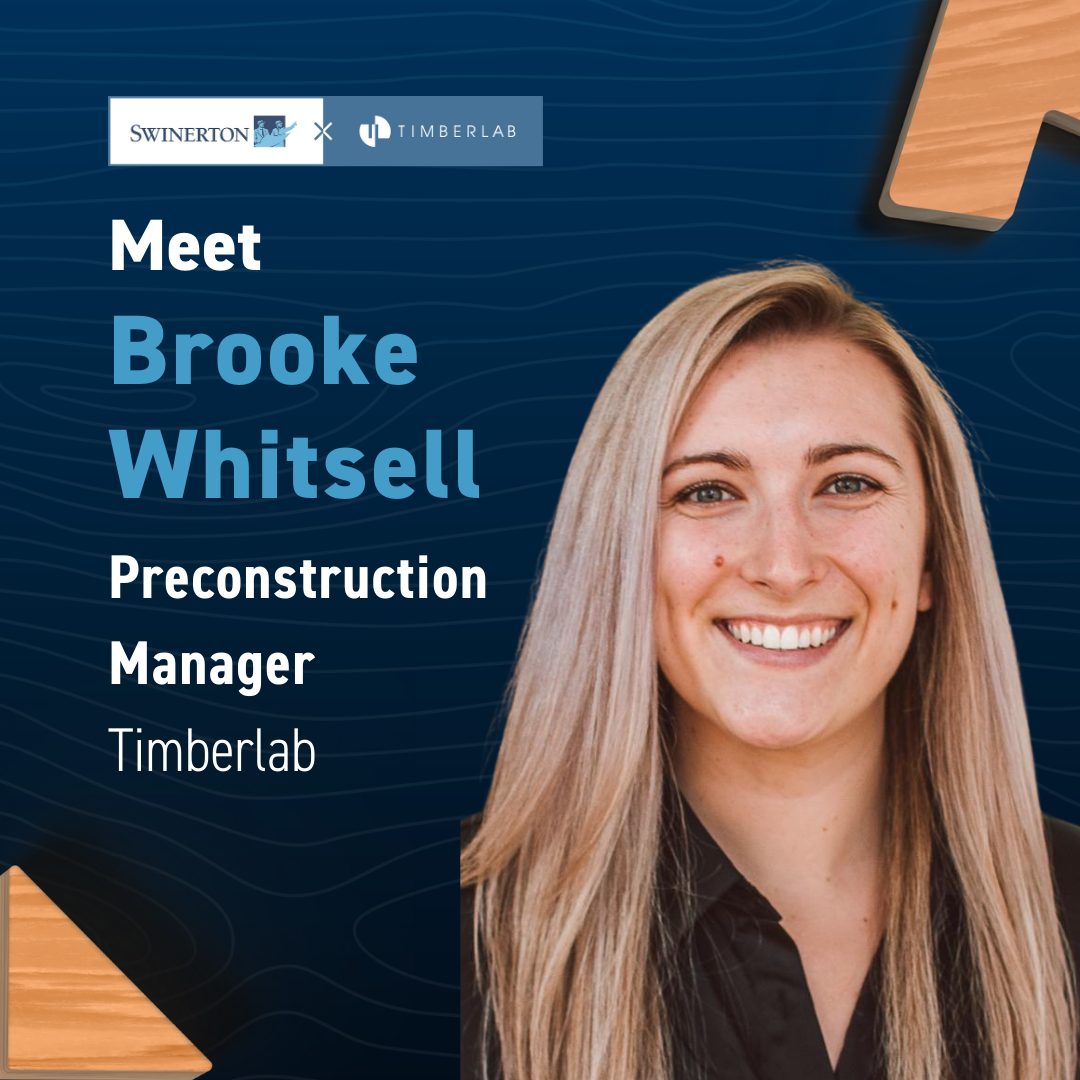
Brooke Whitsell, Preconstruction Manager | South Carolina Division
Mass timber continues to reshape how architects, developers, and builders think about the future of low carbon construction. From accelerating project delivery to improving the human experience inside buildings, the momentum behind mass timber is stronger than ever—across regions, markets, and building types. In this leadership spotlight, we sit down with South Carolina’s Brooke Whitsell, a key voice in Timberlab’s growth and a champion of collaboration between Timberlab and Swinerton.
Mass timber is becoming a preferred building solution across the country as regions look for construction methods that improve speed, reduce carbon, and create better human experiences.
Brooke shares insights from her perspective on innovation, partnerships, misconceptions, and what it will take for mass timber to become the structural system of choice nationwide.
Q: Why is vertical integration between Swinerton and Timberlab such a differentiator?
Vertical integration is crucial because it creates an efficient communication flow within the team, which directly adds value to projects. Our best projects happen when there’s a strong team and strong relationships—and this partnership delivers exactly that.
Q: Can you share examples of successful “Better Together” partnerships?
A standout example for me is Portland State University (PSU) in Portland, Oregon, where we broke our record by installing 76 columns in a single day—a result of five years of experience and collaboration. The Jackson Day Charter School in Charlotte, North Carolina is another great example. As a design-build project, Swinerton’s leadership created a fully collaborative environment, resulting in what we believe is the first mass timber charter school on the East Coast.
Q: How are Timberlab and Swinerton pushing innovation in mass timber?
Research plays a massive role. I see it in three buckets:
• Internal research for our own improvement
• Industry-wide research to advance adoption
• Project-specific research to solve unique challenges
But beyond research, the biggest driver of industry growth is delivering great projects—buildings that are efficient, durable, and meet end-user needs. When we deliver painless, high-quality construction, it builds confidence and accelerates adoption across new markets.
Q: What makes a mass timber project successful beyond cost and schedule?
Success means the client wants to do another mass timber project. If a client walks away saying, “I hated that process,” that’s failure. In this industry, it’s strong partnerships and successfully executed projects that ultimately keep mass timber viable and positioned for long-term success.
Q: Which project types are the strongest fit for mass timber right now?
Education, especially K-12, continues to be one of the fastest growing sectors for mass timber, with school systems embracing sustainability, speed of construction, and the warm aesthetic. Public and civic projects are also a great fit as these buildings often aim to embody community values around environmental responsibility, long-term durability, and stimulating local economies by sourcing regionally.
And I continue to say this over and over: healthcare should be mass timber. Even if it hasn’t fully taken off yet in that market, it’s such a natural match. Wood offers biophilic benefits such as reducing stress, supporting emotional well-being, and improving other health metrics like resting heart rate. All those factors align perfectly with environments designed for healing. A place dedicated to restoring health should incorporate materials that actively contribute to the healing process.
Q: What misconceptions about mass timber are most frustrating?
One of the most frustrating misconceptions about mass timber is the assumption that if the wood isn’t sourced locally, the entire effort is just “greenwashing”. In reality, mass timber is a massive benefit to the effort of reducing embodied carbon in the built environment regardless of where it is sourced.
Additionally, regional priorities and motivations vary significantly. On the West Coast, conversations tend to center on sustainability, carbon, and regional sourcing. In the Southeast, however, their focus is on supporting the local economy and creating jobs. For them, the value of mass timber is rooted in economic impact rather than carbon metrics. This diversity of motivations doesn’t undermine the legitimacy of the material; it reflects the different ways mass timber can serve communities.
Q: Are there client priorities we don’t talk about enough?
Yes—one priority we don’t talk about enough is the immense amount of certainty mass timber can provide, particularly when it comes to cost and schedule. Our strength lies in delivering predictability, and that stems from being builders first. The mass timber industry brings together experts from manufacturing, engineering, and design backgrounds, each offering valuable perspectives. What differentiates us is our approach: we lead with constructability and a commitment to de-risking the project from day one. We’re not here to low-bid and walk away. Our goal is to be a thoughtful, long-term partner who is fully aligned with the success of the entire project.
Q: How do people emotionally respond to mass timber?
People instinctively gravitate toward wood. I’ve witnessed it time and again on building tours—people slowly drift toward a timber column, almost pulled in by it. Timber acts as a magnet to inhabitants and visitors. The Portland International Airport is a perfect example. I’ve never in my life seen hundreds of people walking through an airport with their eyes fixed on the ceiling except in Portland. It’s remarkable how a nine-acre timber roof can captivate even the busiest travelers, stopping them in their tracks to take it all in.
Q: When cost becomes a sticking point, what’s your next move?
My next steps largely depend on where the project is in design. If it’s late—say, 50% CDs with steel already locked in—I’ll honestly say, “Call us earlier in the design process next time.” At that stage, the opportunities to optimize for mass timber’s cost efficiency have mostly passed. But if it’s early and there’s flexibility in the design, then there is room to achieve an extremely cost-effective timber structure. In those cases, the single biggest factor still isn’t the structure itself, it is the general contractor. Timberlab can design the most efficient and beautiful timber structure, but if the general contractor doesn’t want timber, the budget will kill mass timber’s viability. That’s why having a partner like Swinerton is so valuable—they fight for timber as a value-add proposition and know how to make the numbers work.
As mass timber adoption nationwide continues gaining traction, leaders like South Carolina’s Brooke Whitsell are helping shape not only how these buildings are designed and delivered, but how teams collaborate, innovate, and rethink what’s possible in modern construction. Her insights emphasize a powerful truth: the future of mass timber will be driven by strong partnerships, early and informed decision-making, and a commitment to creating buildings that serve both people and the planet. With advocates like Brooke leading the charge—and with the integrated strength of Timberlab and Swinerton behind her—mass timber is steadily moving from an emerging alternative to a proven and compelling solution for the built environment.

