
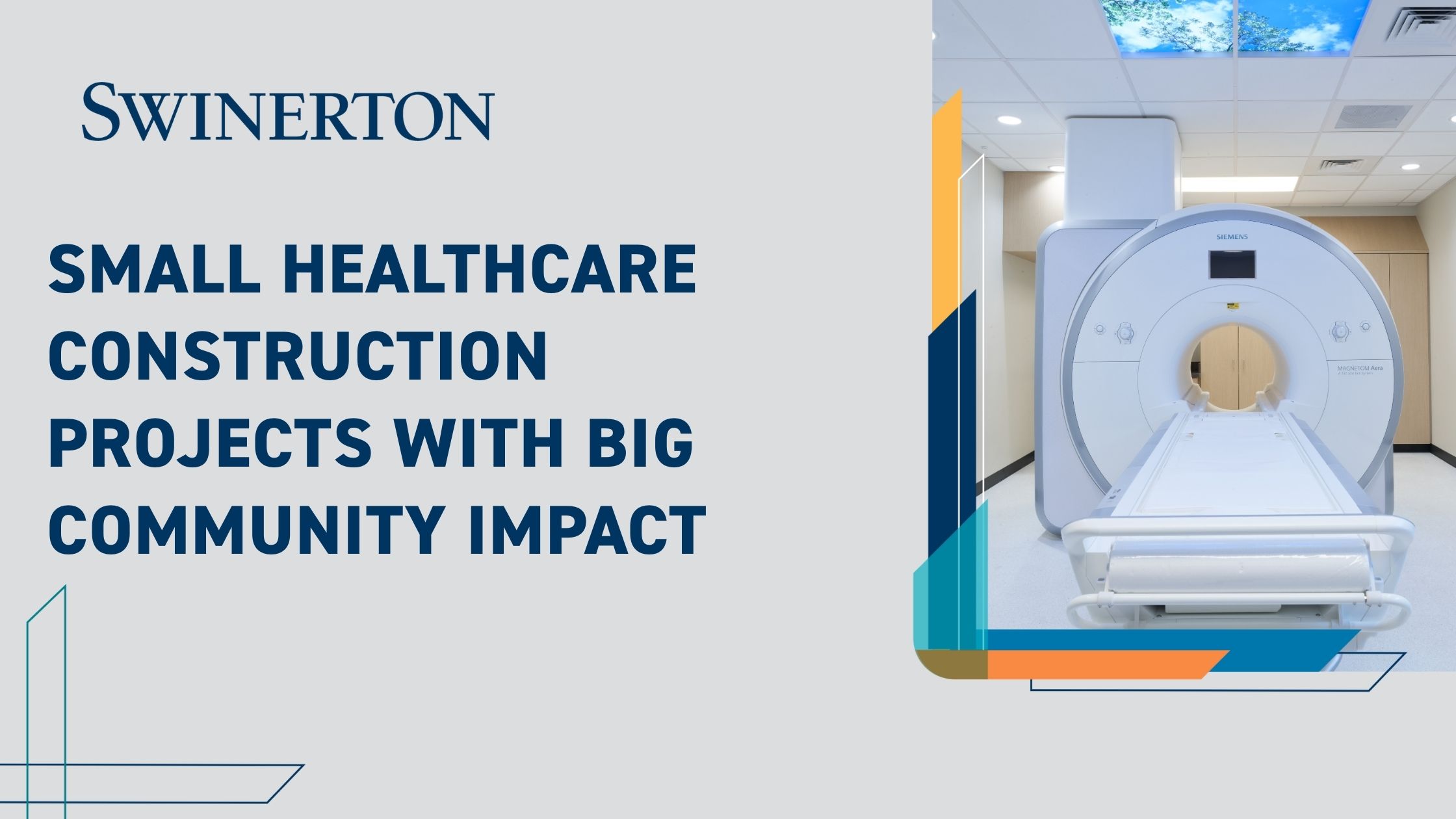
Small Healthcare Construction Projects with Big Community Impact
Swinerton is taking on smaller scale yet complex healthcare projects whose community impact can’t be measured by square footage and cost alone.
Why Size Doesn’t Determine Healthcare Construction Impact
When healthcare construction is done right, it transforms communities—and at Swinerton, we understand that every project, no matter the size, has the power to save lives and strengthen the areas we serve. In Swinerton’s Northwest region, we take on healthcare projects of all scopes, and while they all leave lasting impacts, it’s the “small” projects that truly put into perspective the importance of healthcare construction—square footage will never adequately measure the significance of a healthcare project to the population it serves
Erik Benedetti, Sr. Project Manager and Portland Healthcare Market Lead, has experienced firsthand the impact a small project can have on a community. He shares, “There really is no small project in healthcare. Each has an impact far beyond the actual work area.”
Erik has worked on a variety of healthcare projects, such as three recent medical equipment replacements—X-Ray, Cath Lab, and SPECT/CT—at PeaceHealth Southwest Medical Center in Vancouver, WA. Together, these projects cover less than 2,700 square feet but will provide the Vancouver community with the latest imaging, surgical, and nuclear medicine technology.
Healthcare Construction’s Ripple Effect on Communities
How Small Healthcare Projects Serve as Community Lifelines
Small healthcare projects serve as vital lifelines for communities of all sizes, delivering essential medical services that are just as critical as their larger counterparts. These focused construction efforts—ranging from urgent care centers and specialty clinics to equipment upgrades and facility expansions—create profound ripple effects that extend far beyond their physical footprint.
Bringing Medical Care Closer to Rural and Underserved Communities
In smaller communities, these projects often represent the difference between accessible local care and traveling hours for basic medical services. A new primary care clinic or upgraded diagnostic equipment can transform healthcare delivery for an entire region, keeping families close to home during medical emergencies and routine care. These facilities become anchors of community health, providing preventive care that reduces long-term healthcare costs and improves quality of life for residents.
“By upgrading or expanding specialty services in an underserved area, these projects directly translate to improved patient care and accessibility,” says Erik. “The complexity may be concentrated in a small footprint, but the responsibility to get it right—every system, every detail, every timeline—is just as critical as any large-scale facility.”
Addressing Healthcare Gaps in Metropolitan Areas
For larger metropolitan areas, small healthcare projects fill critical gaps in the healthcare ecosystem. Neighborhood clinics, specialized treatment centers, and outpatient facilities bring care directly to underserved populations, reducing strain on major hospital systems while improving access to specialized services. These projects often focus on specific community needs—whether it’s behavioral health services, women’s health, or chronic disease management—addressing healthcare disparities with targeted solutions.
Innovation Testing Grounds for Future Healthcare Construction
Small healthcare projects also serve as testing grounds for innovative construction techniques and healthcare delivery models. The lessons learned from these focused efforts often inform larger healthcare initiatives, making them essential components of the broader healthcare infrastructure development strategy. Their manageable scale allows for experimentation with new technologies, sustainable building practices, and patient-centered design approaches that can be scaled up for larger facilities.
Project Spotlight: Legacy Woodburn Health Center Expansion
Advanced Diagnostic Imaging for Rural Oregon Communities
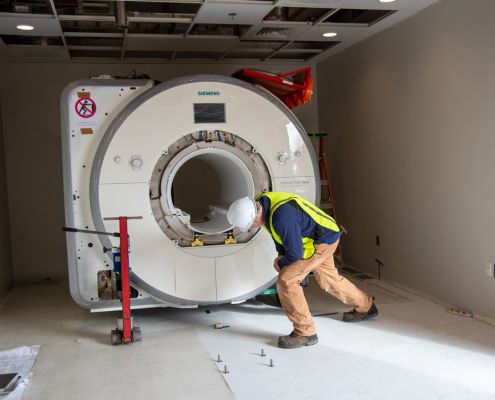
This $5.5 million renovation and expansion adds 8,800–square feet of advanced diagnostic imaging services for Woodburn’s 26,000 residents and nearby rural communities. The facility now includes MRI, CT, X-Ray (including fluoroscopy), DEXA, ultrasound, and mammography units, eliminating the need for residents to travel to more highly populated areas. This investment enhances preventive care and early detection, supporting women’s health and osteoporosis programs locally. The project’s complexity—installing high-tech equipment in an active medical office—highlights the specialized expertise required for small healthcare projects and their significant impact on community access to quality care.
Why Small Healthcare Projects Demand Maximum Precision
Meticulous Planning for Active Healthcare Environments
Smaller healthcare projects demand the same level of precision and coordination as larger facilities. These focused construction efforts require meticulous planning to minimize disruption to active healthcare environments while implementing critical infrastructure upgrades and equipment installations.
Design-Construction Integration and Stakeholder Communication
The construction process emphasizes seamless integration between design and construction phases. Teams facilitate meetings with data-rich content to inform stakeholders and help make effective decisions. Comprehensive meeting minutes document discussion topics and decisions made, which are then integrated into construction deliverables shared at major milestones.
“Everything has to be right when it comes to complex interactions with the systems and operations in a hospital,” Erik notes. “The complexity of the work may actually increase when the square footage is smaller.”
Infection Control and Medical Equipment Coordination Expertise
Working in occupied healthcare facilities requires specialized expertise in infection control, medical equipment coordination, and maintaining essential building systems. Construction teams expect the unexpected and create contingency plans to keep healthcare operations running smoothly. Clear and consistent communication with healthcare leadership ensures affected teams are aware of disruptions or changes in a timely manner.
Project Spotlight: Legacy Health Meridian Park ICU and OR Renovation
Phased Construction Approach for Continuous Hospital Operations
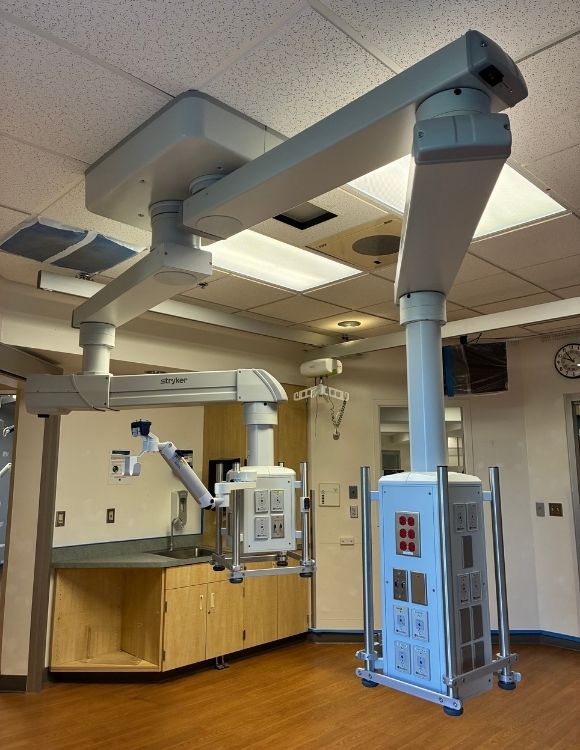
The Legacy project includes the replacement of surgical booms, equipment booms, lighting booms, room lighting, flooring, and wall protection, along with structural modifications and upgrades to medical gas, electrical, and low voltage systems to accommodate new Stryker equipment. To ensure uninterrupted hospital operations, the work will be carefully phased—renovating one Intensive Care Unit (ICU) pod each in the first two phases and two operating rooms (OR) at a time over the next five phases, with a final phase dedicated to finish upgrades in supporting spaces. Each of these eight phases is only about 2,500 –square feet. All activities are being executed under stringent Class IV and V infection control risk assessment (ICRA) protocols to safeguard patient safety and minimize disruption to critical hospital functions.
Occupied Facility Construction: Building Trust Through Partnership
The “One Team” Approach to Healthcare Construction
Working in occupied healthcare facilities demands a collaborative approach that Erik and his team have perfected through years of experience. Their philosophy of working as “one team” with healthcare staff ensures that even the smallest renovation projects maintain the trust and confidence of clinical teams who depend on uninterrupted operations.
Swinerton healthcare teams have learned to expect the unexpected and create contingency plans to keep healthcare operations running smoothly. Our project teams maintain clear and consistent communication with healthcare leadership to ensure affected occupants are aware of disruptions or changes in a timely manner.
“We get to play a small part in creating spaces that care for people when they need it most,” Erik says. “I always keep that in mind in every stage of a project, from initial concept to first patient.”
Three Essential Elements of Successful Occupied Healthcare Construction
Swinerton’s approach to occupied facility construction centers on three essential elements:
- Rigorous pre-planning for all hazardous activities as part of our phasing and logistics plans, which are regularly updated as construction activities and facility needs change.
- Developing contingency plans to ensure there are no disruptions to essential functions such as power, water, air filtration, and medical gas systems.
- Communicating clearly and often with facility leadership about upcoming activities and how we will limit project impact on patients and the community.
This comprehensive strategy, alongside our team’s extensive experience, ensures that all healthcare operations are maintained with the utmost care for patients and staff while delivering successful construction outcomes.
Project Spotlight: PeaceHealth St. John Medical Center
Upgrading Life-Saving Technology While Maintaining Continuous Patient Care
PeaceHealth St. John Medical Center, Longview, WA
Swinerton is providing preconstruction and general contracting services for a repeat healthcare client on a comprehensive renovation of a 1,200-square-foot area that includes a treatment room, control room, and new doctor office. The Lower Columbia Cancer Center’s aging low-photon linear accelerator will be replaced with a state-of-the-art Varian TrueBeam system. Swinerton will implement rigorous infection control risk assessment protocols and interim life safety measures to ensure that the structurally intensive work is completed while the facility remains fully operational and continues providing life-saving cancer treatment to patients.
Conclusion
Upgrading Life-Saving Technology While Maintaining Continuous Patient Care
Small-scale healthcare construction projects require the same level of precision, infection control expertise, and occupied facility coordination as their larger counterparts. Whether it’s a 1,200-square-foot equipment replacement or an 8,800-square-foot imaging center expansion, these focused efforts demand meticulous planning, rigorous safety protocols, and seamless collaboration with clinical staff. At Swinerton, we measure project success not in square footage, but in improved community access to quality healthcare and the lives these spaces ultimately serve.

