
A Mass Timber Builder’s Story
The design and construction of one of the country’s largest state-of-the-art cross-laminated timber manufacturing facilities proves why early collaboration is essential to success.
Designing and constructing one of the nation’s largest cross-laminated timber manufacturing facilities requires more than technical expertise. It requires alignment, flexibility, and above all, a team willing to think and act like owners.
The 192,000-square-foot Independence Hall project is a modern mass timber marvel—a massive, light-filled space that will transform raw wood into components that become other mass timber structures. The facility is the next step in expanding Timberlab’s mass timber capabilities, delivered by Swinerton Incorporated’s own ecosystem. The effort has included Swinerton Builders, Timberlab, Lindgren, SAK Builders (SAK), and Swinerton’s self-perform team. With all parties embracing collaboration from day one, the project has remained collaborative, coordinated, and on-schedule despite unpredictable site conditions, late-arriving equipment and information, and evolving design requirements.
A Foundation for Success
Long before the first dirt moved onsite, the project team invested heavily in relationship-building. An internal partnering meeting brought key stakeholders and design partners together to establish a shared vision.
“That meeting set the tone,” recalled David Green, Operations Manager at Lindgren. “It made it clear we were building this for ourselves. Everyone showed up with an employee-owner’s mindset, and that mindset has shaped the entire project.”
“Those early conversations aligned our goals,” agreed Swinerton Senior Project Manager Ryan Dellit. “From that point, we made decisions with long-term operations and maintenance in mind—not just first cost.”
The team’s cohesion translated directly to speed. They moved quickly through conceptual design, budgeting, and value engineering. Concept drawings wrapped up in June 2024; by August, the first conceptual budget was completed.
“It was nonstop schematic pricing, value-engineering studies, and evaluating everything from earthwork strategies to wall systems and mechanical systems,” said Jon
Smith, Swinerton Preconstruction Manager. “But because the team was aligned from day one, we could move quickly and confidently.”
The structural systems were also carefully evaluated. “Industrial buildings like this are typically pre-engineered metal structures,” added Smith. “We knew we wanted mass timber, but we needed it to align with the required machinery, budget, and intended use,” which required some creative thinking. Working with Timberlab, structural engineers, and equipment vendors, the team aligned building span spacing and grid layout to advance mass timber as the solution.
Constructing the Building for the Equipment
From the start, Independence Hall has been defined by the manufacturing process. The footprint, structural grid, concrete slab, and MEP systems were all designed around manufacturing equipment that was still in the process of being engineered.
“The equipment drove the building,” said Green. “We knew we wouldn’t have complete equipment information until after construction was well underway.”
To maintain the schedule, the team made daring construction choices: build the entire perimeter on footings and stem walls, erect the structure, and delay the slab placement. This atypical approach provided flexibility to finalize the electrical routing below grade and accommodate late-arriving equipment details.
Since Timberlab was modeling architecture, structure, and MEP in a unified 3D environment, the team could iterate quickly as equipment details evolved.
“It was a massive coordination effort,” said Dellit. “But the partnerships and modeling made it possible.”
Site Realities
Independence Hall’s agricultural site brought multiple challenges: soggy soil, wet winter weather, wetlands, railroad adjacency, and environmental oversight.
“Soil conditions were a big early risk,” Dellit said, “but we prepared for that.”
The team leaned heavily on geotechnical inspections and added budget allowances for cement treatment. Swinerton Superintendent Eugene Matveev worked through the impacts daily:
“Some areas needed 15% cement treatment instead of the planned 5% to stabilize saturated ground. We revised the slab, MEP underground, and concrete sequences four or five times.”
Boring under the adjacent railroad four separate times for utilities tested the team’s patience. “I hope to never do it again,” laughed Green.
“It took nine months to get the first right-of-entry permit, which inspectors said was fast compared to the typical year-and-a-half to two-year process,” added Matveev. “I’ll take that as a win.”
Proximity to wetlands also brought strict oversight from the Oregon Department of Environmental Quality. Enhanced filtration, expanded temporary controls, and upgraded permanent systems were integrated to protect the surrounding habitat throughout construction and after the facility becomes operational.
“These requirements added cost and complexity,” said Green, “but they also strengthened the long-term environmental performance of the project.”
Sequencing a Quarter Million Square Feet of Work
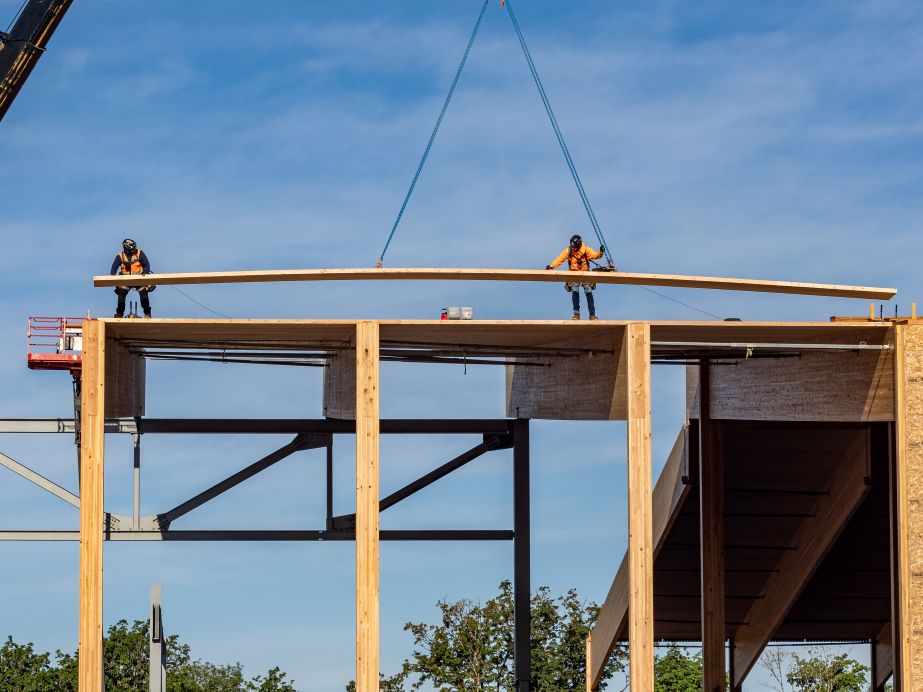
Given the building’s size—about three football fields in length—construction sequencing required precision. The team advanced from north to south: footings, stem walls, mass timber, roofing, slab-on-grade, and follow-on trades, moving in sequential waves.
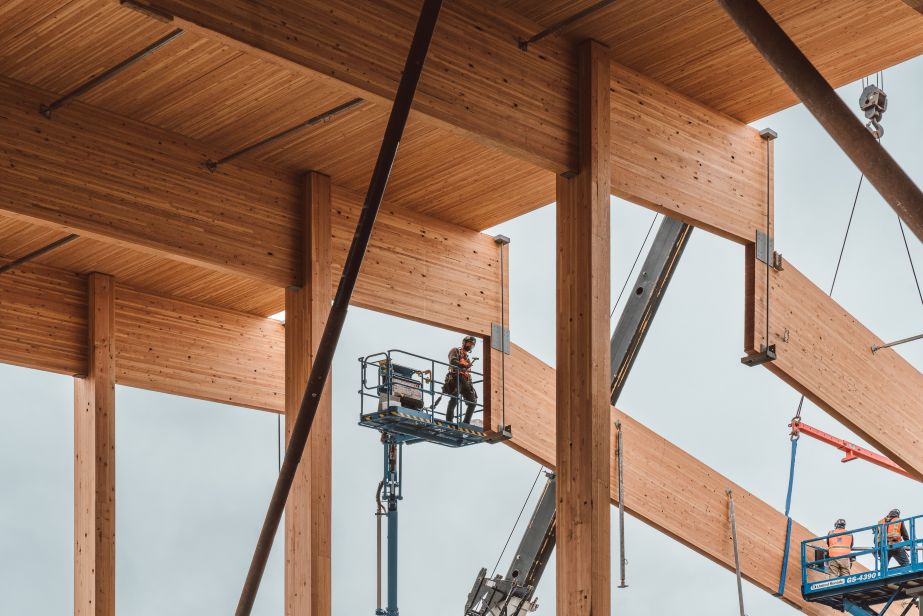
Early mass timber installation moved slowly, with only 50 to 70 feet of progress in the first six weeks due to temporary shoring and the complexity of handling enormous columns and beams.
“Once crews got past shoring, production skyrocketed and the remaining three-quarters of the structure went up in the same amount of time,” said Matveev.
Dellit added, “We ran different sequencing scenarios, but all would’ve pushed timber erection into winter, and we wanted to avoid that. Running those scenarios early set us up for success.”
Testing Adaptivity and Schedule Flexibility
As slab pours approached, Timberlab expressed concerns about slab curl and the associated cracking risks, given the expansive footprint. Traditional rebar reinforcement would have required a significant number of control joints— undesirable in a manufacturing environment needing precise equipment alignment.
SAK proposed a fiber-reinforced structural slab solution that would dramatically reduce the number of joints and improve slab performance.
“We’ll have less cracking and fewer joints,” said Green. “For a facility with heavy forklift loads, equipment vibrations, and long-term operational wear, this solution not only addresses Timberlab’s concerns but is also a major lifecycle advantage.”
The slab redesign required rapid coordination among SAK, Swinerton, Timberlab, and the MEP teams, all while equipment deliveries were being accelerated and underground routing was still being finalized.
Equipment began arriving in November 2025, four months earlier than originally planned.
“To hold the schedule and accommodate the equipment arrival, we pulled forward the office build-out, adjusted slab areas, and modified access points,” explained Matveev.
Dellit concluded with pride, “Our end dates are sticking, and that’s proof of flexibility in planning.”
Technology Elevating Quality and Efficiency
Independence Hall became a testing ground for new technologies, including thermal drones for inspection. “Given the size of the building, manually inspecting the roof would have taken forever,” said Green. With more than four acres of roofing, drones were flown regularly to detect moisture, inspect membranes, and verify weather barriers.
“We wanted to test the new drones, and this was the perfect place,” shared Matveev. “The drones flagged pockets of moisture, allowing further investigation and immediate correction.”
ADDITIONAL TECHNOLOGIES INCLUDED:
- Autodesk Forma Build (Formerly ACC Build) for project coordination
- Emlid GPS layout tools for select site features
- Full 3D modeling by Timberlab of architecture, structure, and MEP
- CFD (Computational Fluid Dynamics) analysis to determine optimal placement and performance of HVAC systems
Moments Making It Count
For many, the moment of greatest pride came when the building’s scale became real.
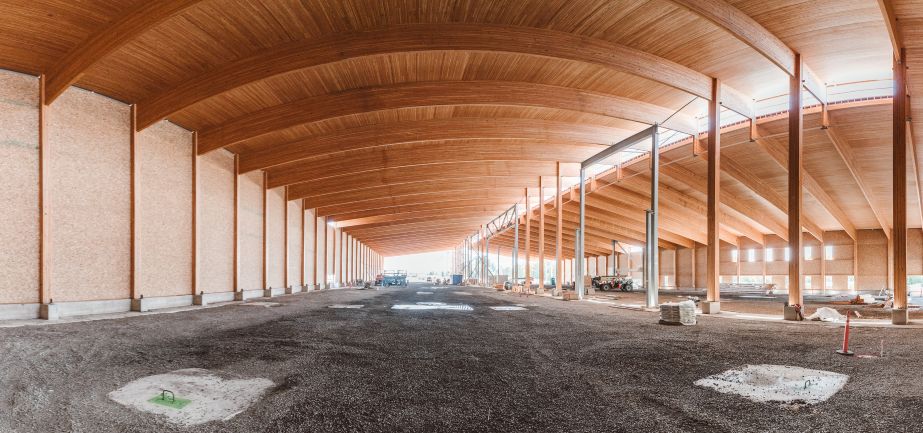
“Walking inside for the first time after enclosure and seeing trucks at the far end looking like Hot Wheels vehicles—that was incredible,” recalled Dellit.
Smith reflected on the groundbreaking as being the most poignant moment for him, when preconstruction efforts translated to reality.
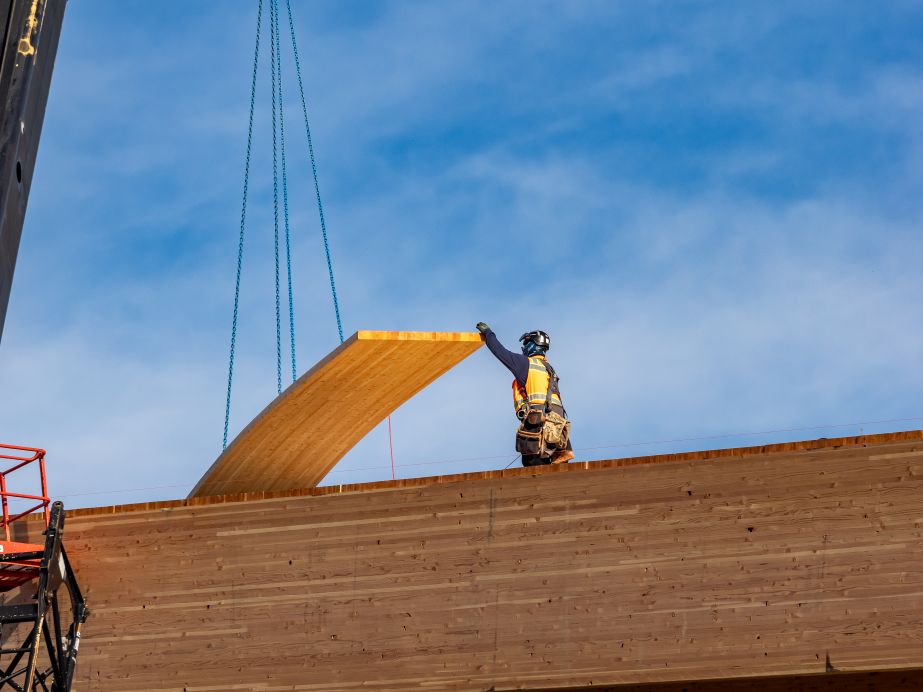
Green pointed to the first massive beam lift: “It was an aha moment. Pictures don’t do the size justice.”
Through early alignment and real-time flexibility, Swinerton and its partners are turning a complex, evolving vision into a cohesive, buildable reality. As the jobsite winds down and the first machines come online, the project team sees more than the structure they built: they see the collective effort of employee-owners who have showed up as one team and proved what is possible when a project is delivered with intention.

