
How Design-Build Helps Public Owners Reduce Risk on Civic Construction Projects
Why Public Owners are Reconsidering Delivery Methods
By: Jeff Ratcliff, Director of Preconstruction, Swinerton’s Carolinas Division
With the continued influx of people and businesses to the Southeast, public entities are under increasing pressure to expand and modernize infrastructure to support rapid population growth. Communities are investing heavily in public safety facilities, educational campuses, transportation infrastructure, healthcare facilities, and utility systems to keep pace with sustained growth. At the same time, agencies are navigating increasing funding constraints, prolonged procurement timelines, and mounting pressure to deliver projects more efficiently. As a result, delivery certainty has become just as important as cost and schedule performance.
While the design-build delivery method is not new to the region, it remains significantly underutilized, particularly among public-sector clients. This is often due to a limited understanding of its benefits, especially for agencies seeking greater control over outcomes. With increasing public scrutiny and growing demands for efficiency, design-build presents an opportunity for municipalities to improve project delivery while maintaining accountability and transparency.
What Makes Design-Build Different
Design-build offers public owners a single, accountable partner for both design and construction—simplifying oversight and reducing coordination risk. It is most effective when speed to market, cost certainty, or project complexity are primary drivers, enabling faster delivery, fewer change orders, and more reliable outcomes. By integrating design and construction under a single contract, accountability for coordination, constructability, schedule performance, and budget management is consolidated. This reduces the potential for disputes between designers and contractors while providing owners with a single point of responsibility when challenges arise. The methodology also accelerates decision-making, helping public agencies navigate one of the most common obstacles in civic projects: lengthy review and approval cycles. When paired with a well-structured procurement process and clearly defined performance requirements, design-build can provide transparency and accountability while still accelerating project delivery. While some public agencies view design-build as requiring a tradeoff between speed and owner control, successful projects often achieve the opposite. By establishing performance requirements, operational priorities, and stakeholder expectations early, owners retain strategic control while empowering an integrated team to optimize execution.
Proof From Public and Community-Serving Projects
Successful Swinerton design-build projects across the country demonstrate the measurable value of this methodology, particularly in highly complex or mission-critical environments where coordination, speed of decision-making, and risk management are essential. For public owners throughout the Southeast, these nationally-learned lessons are becoming increasingly relevant as agencies balance growth, funding limitations, and heightened expectations for project delivery.
The Bay Area Rapid Transit (BART) Police Department Headquarters, a progressive design-build conversion of a five-story office building, exemplified the benefits of integrated collaboration. The 105,000-square-foot buildout required significant seismic upgrades, including additional steel supports, double-cased micropiles, and strategically placed lateral viscous dampers. Complicating the effort was the adjacent active BART tunnel, which required the team to prevent any additional load transfer while maintaining uninterrupted operations. This level of complexity demanded the close coordination inherent in design-build, enabling a unified team to make faster decisions, minimize miscommunication, and adapt solutions in real time to keep the project on track.
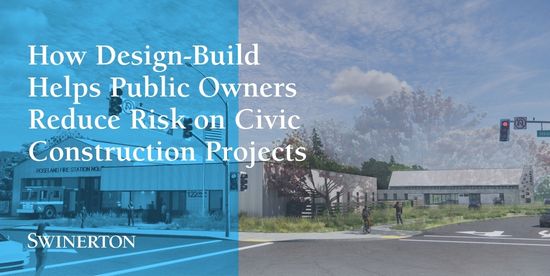
Similarly, the in-progress Santa Rosa Hearn Community Hub illustrates how design-build supports holistic, community-focused public development. In partnership with the City of Santa Rosa, Swinerton is delivering a centralized civic campus that enhances safety, education, and community connection through upgraded infrastructure, public spaces, and new facilities—including Fire Station #8 and the city’s first library in two decades. Building on early concepts developed by Kitchell and Group 4 Architecture, Swinerton’s design-build team has advanced the project with an emphasis on flexibility, constructability, and long-term adaptability. Overlapping design and construction phases accelerated the schedule while continuous collaboration facilitated the mass timber structure of the library, which recently achieved the topping out milestone. When environmental challenges emerged, the team quickly navigated compliance requirements related to sensitive habitats, air quality, stormwater, and cultural resources, demonstrating the agility that design-build enables. Through this methodology, the City of Santa Rosa has reduced project risk by establishing performance objectives early while assigning responsibility for design coordination, constructability, schedule management, and budget performance to the design-build team. This enables City leadership to focus on strategic decision-making rather than day-to-day project coordination.
Public-sector projects, while often associated with first responder facilities and community centers, can also span markets like aviation and healthcare to address a variety of community needs. For example, Swinerton’s Atlanta division partnered with Grady Memorial Hospital, one of the largest publicly owned hospitals in the United States, to deliver two design-build projects supporting ongoing campus upgrades and expansion efforts. The first, a temporary fourth-floor genetics lab, allowed critical DNA research to continue while a permanent facility is under construction. Executed within an active hospital environment, the project required precise coordination with hospital operations, including off-hour work and controlled material logistics. Strict Infection Control Risk Assessment (ICRA) measures—such as hard barriers, HEPA filtration, air scrubbers, and negative air systems—ensured a safe environment for patients and staff. In parallel, Swinerton renovated administrative office spaces, modernizing layouts and enhancing functionality. The integrated design-build team minimized scope gaps and ambiguity around responsibilities, enabling efficient delivery and tailored solutions within an accelerated timeline. While many design-build success stories originate in mature markets, similar benefits are increasingly being realized across the Southeast as public owners seek more efficient ways to deliver critical facilities under growing schedule and funding pressures. The benefits demonstrated across these projects are increasingly relevant to public owners throughout the Southeast, where growing demand for civic infrastructure is creating pressure to accelerate delivery timelines while maintaining accountability for public spending.
How Swinerton Supports Public Owners
Across these projects, a consistent theme emerges: design-build fosters true partnership. By aligning owners, designers, and builders from the outset, clients benefit from early cost certainty, proactive value engineering, and fewer downstream surprises. This is particularly critical for public agencies tasked with stewarding taxpayer funds and delivering reliable outcomes. When implemented effectively, design-build provides public agencies with enhanced collaboration, clearer accountability, and improved visibility into project risks throughout the delivery process. Swinerton’s growing design-build expertise across the country and particularly in the Southeast positions the firm to bring coordination, flexibility, and delivery confidence to local clients facing growing pressures.
What Public Agencies Should Plan For Early
While project outcomes vary, the most successful design-build efforts share common characteristics established long before construction begins. For public agencies, the value of design-build extends beyond efficiency. Its greatest benefit is alignment—bringing together decision-makers, designers, builders, and end users around shared objectives from the earliest stages of project development. By bringing together a unified team early, clients gain a partner invested in shared outcomes, community impact, and responsible stewardship of public funds. It enables teams to prioritize local workforce engagement and deliver infrastructure that reflects the needs of the communities served.
As public entities across the Southeast work to meet growing demands, design-build represents a powerful yet underleveraged tool. With the right partner, it offers a smarter, more collaborative approach to delivering the infrastructure communities depend on.
To realize its full value, public owners should treat early phases as a strategic planning and governance process. Establishing clear decision authority and approval pathways upfront prevents delays and ensures timely escalation. Defining funding boundaries and distinguishing what is fixed versus flexible allows teams to set design priorities early and responsibly steward taxpayer dollars.
Equally important is aligning stakeholders around a shared definition of success. When agency leaders, end users, and project partners are aligned from the outset, coordination improves and late-stage scope changes—and the public friction that often follows—are minimized. This alignment should extend to a clearly defined basis of design and operational priorities, ensuring the facility performs as intended from day one and over its full lifecycle.
A proactive approach to risk is also critical. Developing and maintaining a project risk register early in the process helps identify potential schedule, budget, procurement, and operational challenges before they affect construction. Assigning responsibility for mitigation strategies enables teams to proactively address issues while maintaining transparency with stakeholders and the public.
When these elements are addressed early, design-build enables faster decision-making, stronger cost control, and fewer disruptions—positioning public agencies to deliver high-performing projects with greater confidence and predictability.
Design-build is not the right solution for every project. However, when schedule certainty, collaboration, accountability, and risk management are priorities, it provides a proven framework for delivering complex civic infrastructure more efficiently.
For public owners willing to invest in early stakeholder alignment, clear decision-making pathways, and proactive risk planning, design-build offers an opportunity to reduce uncertainty, improve project outcomes, and deliver critical community infrastructure with greater confidence while remaining responsible stewards of taxpayer resources.

