
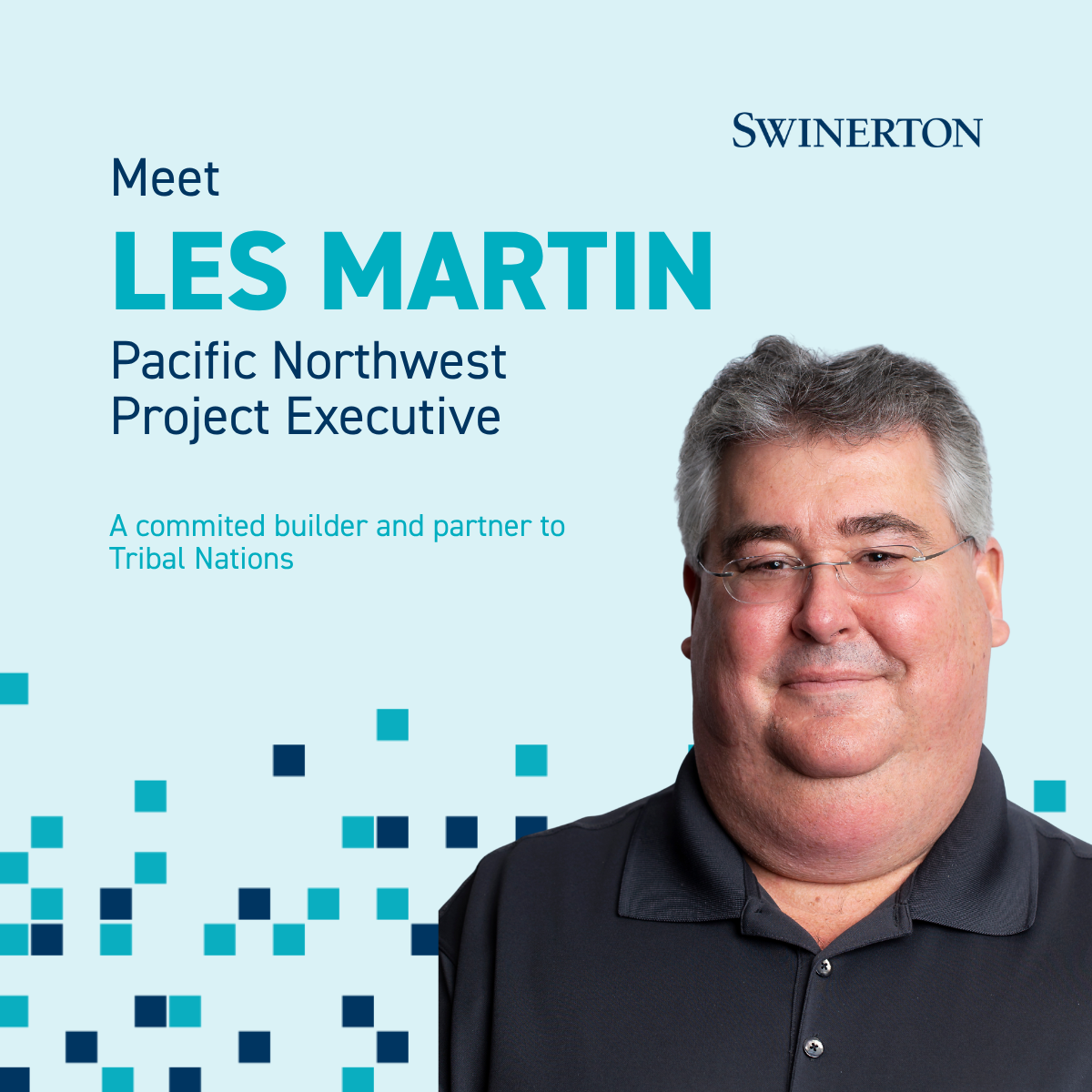
Les Martin: A Relationship-Driven Approach to Building with Tribal Nations
Les Martin is passionate about delivering projects that enhance guest experiences, strengthen Tribal communities, and create lasting partnerships.
After moving to the Pacific Northwest over 20 years ago, Les worked on his first Native American project, an experience that has shaped his career to this day. As a project executive with Swinerton, he has delivered a diverse portfolio of Native American projects on a broad spectrum of projects, from ground up hotels and casino expansions, to healthcare clinics and community facilities. Along the way, he’s found his passion rooted in the relationships he’s built with Tribal leaders and community members.
Now in his 13th year with Swinerton’s Seattle team, Les leads projects across Washington, Idaho, and Oregon. He thrives in the dynamic environment of the Native American market and prioritizes time on the job site working closely with the project teams and clients. Some of his most significant projects include the 7 Cedars Casino Hotel Expansion, Spokane Tribe Casino STEP Phases 1–3, and Emerald Queen Parking Garage.
Continue reading to learn how Les enhances guest experiences, builds trusted partnerships, and supports Native American communities through TERO initiatives.
Market Evolution
How is the Native American construction market changing in 2026, and where do you see it in 2030?
Early in the Native American construction market, many contractors lacked experience navigating Tribal processes, like sovereign immunity. Now, the market is becoming more competitive as firms gain a deeper understanding.
At the same time, Tribal owners are increasingly sophisticated and knowledgeable about the construction market. They have higher expectations, which raises the bar on quality and performance across all project types.
What is driving Tribal Councils to invest in healthcare, administrative facilities, and community infrastructure right now, and how does that change the conversation Swinerton has with Tribal owners?
Historically, many Tribal Nations built their economic foundations through gaming, which continues to fund a large portion of community operations. Today, we’re seeing more Tribes reinvest those revenues into healthcare, education, and community infrastructure.
As a result, conversations with Swinerton are evolving. We’re drawing on experience from across multiple sectors, not just gaming, to support projects like community centers, healthcare facilities, and even renewable energy such as solar and waste-to-energy systems. It’s an exciting shift as the range of opportunities continue to expand.
Project Strategy
For a Tribal Council in early planning for a non-gaming project, what is the single most important preconstruction decision they can make to protect long-term value?
The most important preconstruction decision will always be bringing Swinerton in early to help steer the cost, schedule, and constructability of their projects, so they get maximum value for their dollar.
Walk us through one example where Swinerton’s role on a non-gaming Tribal project expanded beyond the original contract scope. What made that possible?
We have done convenience stores and gas stations for the Snoqualmie Indian Tribe and Cowlitz Indian Tribe, administrative buildings, and healthcare clinics.
In many cases, that work has grown out of long-standing relationships built over years or even decades. After successfully delivering large projects, we’re often asked to support smaller renovations and repairs as needs arise. That trust, and our familiarity with each Tribe’s priorities, allows us to complete a wide range of project types and scopes.
What does Swinerton’s phasing approach actually look like inside an active 24/7 gaming environment, and where does it diverge from a standard renovation playbook?
In the gaming environment, every machine taken offline represents lost revenue, so you need to be very cognizant of how much gaming you’re going to have to take offline. We work closely with ownership to understand how the gaming floor will function throughout construction and minimize disruptions.
At the same time, we consider how the phasing plan will relate to the guest experience: what will they be seeing, what will they be hearing, how will this affect their entrance and exit from the building, and how will they move from one venue to another. This level of coordination goes well beyond a standard renovation approach.
What does “guest experience continuity” mean during heavy construction in an operating casino, and how does your team actually deliver it?
In a 24/7 casino environment, maintaining the guest experience is understanding how and when people use the space. While casinos never fully close, there are natural ebbs and flows throughout the day and week that allow construction to occur with minimal disruption.
On many renovation construction projects, crews work nights or weekends to minimize disruptions.. In the gaming environment, however, the least disruptive windows are often early mornings, before guest activity picks up later in the day and throughout the weekend. Understanding those traffic patterns allows our team to schedule more impactful work when it will have the least effect on gaming operations and the guest experience.
By carefully scheduling more disruptive activities during these periods and coordinating closely with ownership, the team can limit impacts to the gaming floor and ensure guests can move through the space comfortably.
Workforce Partnership
TERO is often discussed as a compliance requirement. What does it look like when it is treated as a partnership instead?
In my opinion, TERO is always a partnership. It’s a conversation you have with ownership during the preconstruction phase. It’s meeting with the TERO office, general managers, and with the tribes to understand their TERO goals and make a plan to reach them.
Each Tribe’s program is different, so success comes from listening, aligning expectations, and creating opportunities that reflect their priorities.
Tribal leaders care about workforce outcomes — apprenticeships, mentorship, careers — not just hours billed. How does Swinerton support that on a Tribal project?
On multiple projects we have required the subcontractors to host workshops about their trade that give TERO workers an up-close, personalized look into the work our teams are doing. We covered everything from concrete and framing to roofing and glazing.
What is one thing contractors get wrong about TERO most often, and what does getting it right actually look like?
A common misconception is treating TERO as a short-term requirement, as opposed to the real goal of getting tribal members employed and gaining skills for the long-term. TERO is a great program that when approached properly, can create real, lasting career growth for Tribal members.
Lasting Relationships
What is the single most important quality Swinerton brings to a Tribal owner conversation that establishes an enduring partnership?
Transparency.
We’re open about cost, schedule, and expectations, and we focus on building long-term relationships. Trust is established through consistency, honesty, and delivering on what we promise.
What would you tell a Tribal Council that is about to engage a general contractor on a landmark project for its community?
The key to hiring a general contractor is to find someone that you trust and that has deep experience in Native American construction. This construction type is not the same as general construction; there are important differences that require specific knowledge and understanding.
A contractor with a strong track record can help navigate those nuances and set the project up for long-term success.
Final Takeaways
For Les Martin, success in Native American construction goes far beyond delivering a completed building. It is about earning trust, understanding each Tribe’s unique goals, and creating projects that contribute to long-term community growth. Whether supporting a casino expansion, healthcare facility, administrative building, or community infrastructure project, his approach remains the same: listen first, communicate transparently, and build lasting partnerships. As Tribal Nations continue to invest in the future of their communities, Les and the Swinerton team remain committed to bringing deep market expertise, a focus on guest and community experience, and a relationship-driven mindset to every project.
If you are exploring a project or looking for a partner who understands the unique priorities of Tribal communities, contact our team to learn how we can help bring your vision to life.

