
Regional Mass Timber Spotlight
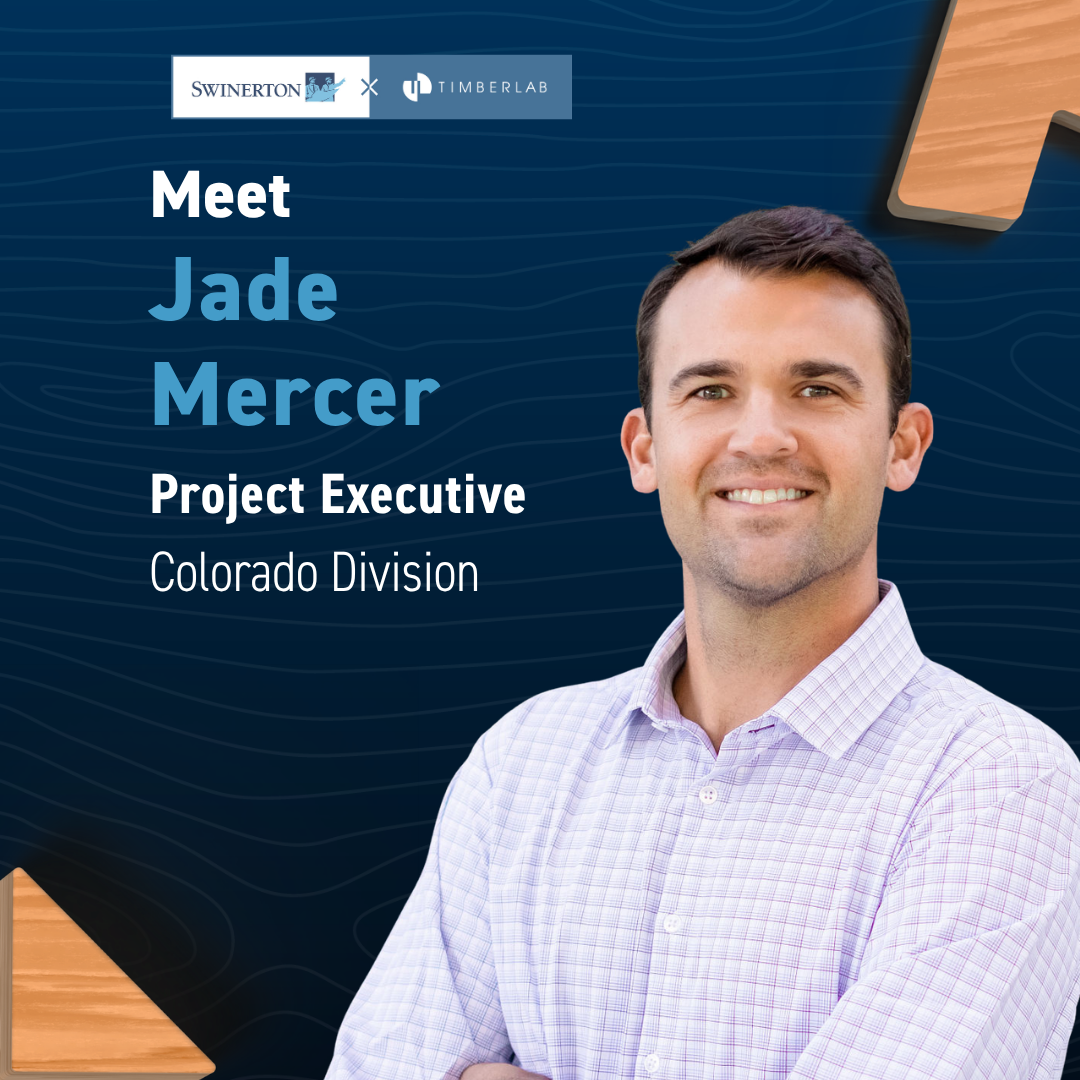
Building the Future of Colorado Mass Timber: A Conversation with Jade Mercer
From the way he guides teams to the thoughtful relationships he builds with clients, Jade’s leadership shows up in both the big moments and the everyday decisions that shape a project. As a Colorado-based Project Executive and Education Market Lead for the Colorado division, Jade is leading some of the region’s most innovative mass timber work.
With nearly 19 years of education construction experience, he understands the complexity of working on active campuses and the importance of designing spaces where students and educators thrive. His passion for mass timber has become a defining part of his work in Colorado. Through hands-on project experience and close collaboration with Timberlab, Jade has helped expand awareness of mass timber’s sustainability, wellness, and schedule advantages, guiding Colorado institutions toward smarter, more efficient building solutions.
Q: Where did you grow up and where did you go to school?
I spent my early years in the Midwest—ten years in Iowa and three in Minnesota—before moving to Fort Collins at age 13, where I attended high school and later stayed for college at Colorado State University. I started as a civil engineering major but switched to construction management after about a year and a half when I realized it was a better fit for me.
Q: How did you get into the construction industry?
I grew up around home improvement projects—my parents were always adding on or renovating. When we moved to Colorado, my uncle, who is an architect, designed the house that we built and lived in, so construction was always part of the backdrop. I was intrigued by it early on and growing up I thought I wanted to be an architect or a home builder.
When I chose to attend Colorado State University and realized architecture wasn’t offered, I picked the closest major: civil engineering. About a year and a half into the program, I realized I wanted to be out in the field, closer to the work and the people. An advisor mentioned that some engineering students discover their interests leaning more toward construction management. I hadn’t realized that was an option—but once I switched, it immediately felt like the right fit. I connected with the people, the work clicked, and academically I did much better.
Before interning with general contractors, I had several hands-on summer jobs—working in a custom sign shop, landscaping, and doing commercial framing and drywall. All of it reinforced that the construction industry was where I wanted to be.
During college, I continued to gain field experience before interning with my first commercial contractor. I graduated in 2008 during a challenging economic period, and I was fortunate that my internship led to a full-time position. From there, I grew from Project Engineer to Senior Project Manager and ultimately developed a deep resume and passion within the education market.
Q: What led you to Swinerton?
Several things drew me to Swinerton. The first was the opportunity to work for an employee-owned company—that was a huge draw for me. I was also excited about an opportunity to help build and strengthen the education market for the Colorado division where I saw enormous potential. But ultimately, it was the people that made the difference. I already knew and respected many Swinerton team members and their encouragement and enthusiasm for the culture is what led me to explore the opportunity. Once I did, it was clear that Swinerton’s values and growth mindset aligned with the direction I wanted to take in my career.
What ultimately motivated me to make the move was the growth potential at Swinerton. I saw a company that recognizes capability and drive—not just age or tenure. Swinerton creates opportunities for people who are motivated, ambitious, and ready to lead. That philosophy aligned perfectly with the next stage I wanted in my career.
When I considered the strength of the people, the employee ownership model, the opportunity to build and lead the education market, and the room for real growth all added up. That’s what led me to Swinerton.
Q: What were your first opportunities working with mass timber in Colorado?
My early exposure to Colorado mass timber came before I joined Swinerton, and it was one of the things that drew me to Swinerton—in particular the commitment to innovation and the growing capabilities of Timberlab.
My first exposure to mass timber was touring my previous firm’s construction of the Platte 15 office building, Denver’s first commercial mass timber office building. Shortly thereafter, I was fortunate to have the opportunity to lead the construction of the Great Dharma Chan Monastery in Boulder. At the time, mass timber still felt new and somewhat unrefined, so that project became a crash course in how the systems come together. It was a very fragmented approach. We hired a design-assist firm to coordinate between the architect, engineer, and the detailing and connection work needed for mass timber prefabrication. However, procurement and installation were handled by separate companies, creating a disjointed process that required multiple parties to come together. In comparison, Timberlab has everything in one place as a truly integrated partner.
When I joined Swinerton, Timberlab was still in its early stages, but I was able to take part in training, workshops, and project tours that deepened my understanding of the material. I spent time in Portland touring their facilities and studying projects like community centers and gymnasiums that showcased mass timber’s full potential. Those experiences helped me bring new ideas back to our Colorado clients.
Around the same time, we were beginning work on the Denver Public Schools Responsive Arts & STEAM Academy (RASA), who were aiming to be leaders in sustainable, forward-thinking design. We showed them the possibilities of mass timber, helped them understand the cost of tradeoffs, and ultimately delivered a solution that was cost neutral. That collaboration resulted in the first K–12 school in the state to incorporate cross-laminated timber (CLT).
Since then, I’ve continued to stay connected to the mass timber world, advocating for it, building relationships, and helping clients understand its benefits. We’re about to break ground on two Colorado mass timber buildings at Fountain Valley School in Colorado Springs, CO and we are in preconstruction on another future ground up mass timber elementary school in Denver.
What’s exciting is seeing more education clients embrace mass timber not just for sustainability, but also for its positive impact on learning environments. Research shows that the warmth, daylight compatibility, and biophilic qualities of mass timber reduce stress and improve cognition—students feel better in those spaces, and it shows.
Those early projects, paired with Swinerton and Timberlab’s expertise, really set the foundation for the mass timber work we’re able to deliver in Colorado today.
Q: What are you particularly passionate about/what excites you about mass timber construction?
It’s a beautiful product. When you step into a mass timber building you feel a difference immediately. It’s a space you want to be in. And from my perspective as someone who builds learning environments, being around nature has been shown to reduce stress and improve cognitive function. It’s making a difference in the lives of the students and staff.
Q: How has Swinerton’s partnership with Timberlab benefited you on one of your projects?
Our partnership with Timberlab has been an incredible asset across every phase of our mass timber projects. Whether it’s Denver Public Schools Responsive Arts & STEAM Academy (RASA) or Fountain Valley School, having true experts embedded as an extension of our team has made a noticeable difference from the pursuit phase through installation. It positions Swinerton as the go-to contractor for mass timber, because clients can immediately see that we bring a level of expertise and integration that others simply don’t.
Before I joined Swinerton, I worked on a mass timber project where the process was completely fragmented, which creates a steep learning curve, coordination issues, and unnecessary inefficiencies.
Timberlab removes all that friction and serves as a true one-stop shop for detailing, procurement, manufacturing, and installation. That alone brings a level of confidence and reliability you don’t get with a disconnected approach. And now that we manufacture our own glulams and CLT we’ll have even more control over lead times and supply chain predictability.
My favorite part of partnering with Timberlab is their support during preconstruction. They work hand in hand with design teams, offering smart recommendations on how to make the structure more efficient and cost-effective without compromising the design intent. Their guidance has resulted in better solutions, cleaner details, and real savings for our clients.
Q: What trends are you seeing in the mass timber market here in Colorado?
We’re seeing a lot of momentum behind mass timber across Colorado, and the market is growing in an intentional way. A big driver of this is the work being done by advocacy groups like the Colorado Mass Timber Coalition, which includes more than 45 organizations—Swinerton and Timberlab among them. The coalition is focused on forest health, sustainability, and climate solutions, including long-term strategies for sourcing Colorado timber. Local sourcing is limited today, but there’s tremendous potential, especially as a tool to help reduce wildfire risk by thinning overly dense forests.
We’re also seeing strong industry engagement through the annual Mass Timber Group conference, which continues to pull in owners, designers, contractors, and vendors from across the state. The goal is education and awareness, and it’s working: more project teams are exploring mass timber early and understanding its benefits.
One of the biggest trends is the growth of institutional adoption. Climate goals and carbon reduction commitments are pushing universities, districts, and public agencies to seek lower carbon materials—so schools and higher education campuses are leading the charge. We’re seeing interest and adoption from institutions like Metropolitan State University of Denver, University of Colorado Boulder, Colorado State University, Aims Community College, and Denver Public Schools to name a few. These clients also increasingly recognize the health and wellness advantages of mass timber, particularly in learning environments.
There is a strong connection between biophilic design and student wellbeing, and exposed timber plays a huge role in that. Studies consistently show that environments with natural materials—especially wood, can reduce stress levels, improve cognitive function, and support overall wellness. You feel a sense of warmth in these spaces that’s hard to describe until you’re standing in one. That experience resonates deeply with educators and students, and it aligns with the growing focus on mental health and whole person learning.
Overall, Colorado’s mass timber market is expanding because the benefits are aligning perfectly with the state’s priorities: sustainability, forest health, carbon reduction, and better human-centered environments. With the continued work of advocacy groups, growing institutional awareness, and more local success stories, the momentum is only increasing.
Key Takeaways
Today, Jade continues to help shape the future of Colorado mass timber, guiding clients, students, and communities toward more sustainable and human-centered spaces. His work across northern, central, and southern Colorado—in cities like Fort Collins, Denver, Boulder, and Colorado Springs— reflects the increasing momentum behind mass timber in Colorado’s education and institutional markets.
