
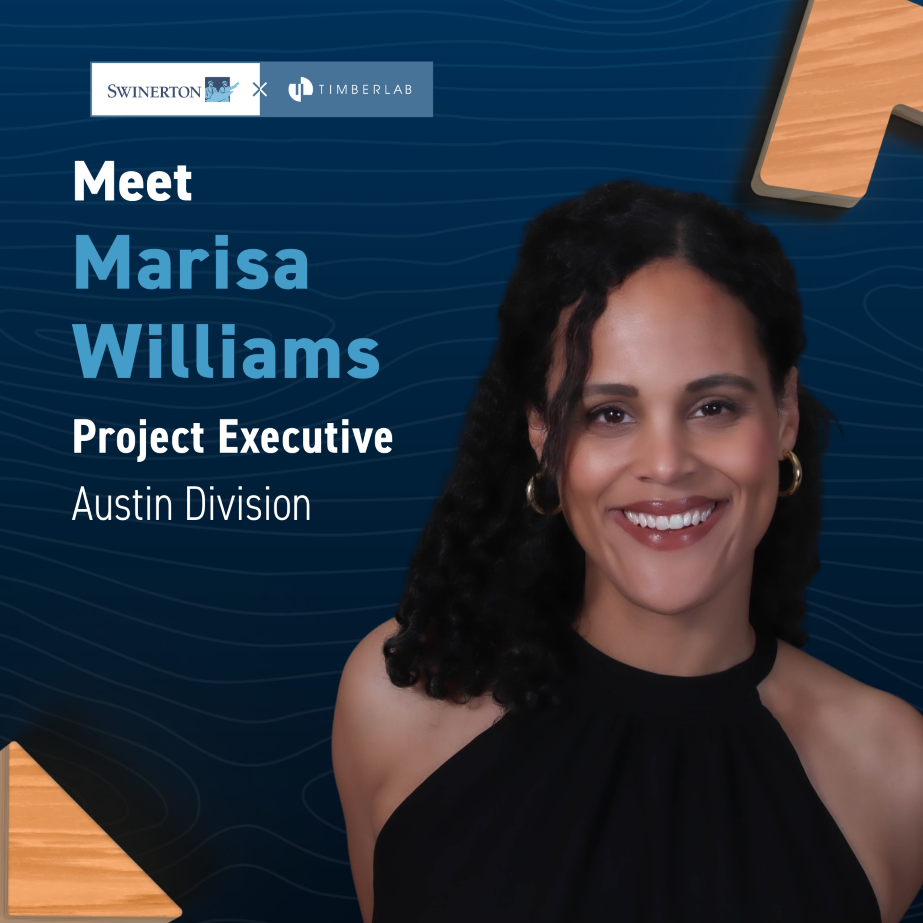
Regional Mass Timber Spotlight
Marisa Williams, Project Executive | Austin Division
Mass timber is rapidly emerging as one of the nation’s fastest‑growing construction solutions. Central Texas is positioned to become one of the next major hubs for adoption of mass timber, as the region focuses on design quality, sustainability, and community‑centered development.
As the Austin region continues to experience population growth, increased development activity, and rising interest in sustainable building solutions, mass timber is gaining traction across public, civic, and higher‑education sectors. In our latest mass timber spotlight, we talked with Marisa Williams, Project Executive with our Swinerton Austin division, about her unique career path, her vision for mass timber in Austin and Central Texas, and the benefits of the Swinerton x Timberlab partnership.
Q: Where did you grow up and where did you go to school?
I’m proud to be born and raised in the beautiful city of San Francisco, California. I spent the majority of my life there, and the city really shaped who I am. I went on to attend San José State University, where I studied civil engineering and played basketball during my first few years. While college was formative, I often think back to high school as the time when my career path really began to take shape.
I took an engineering course that covered environmental, mechanical, electrical, and even some robotics concepts. I was especially drawn to environmental and civil engineering. It was a time of heightened awareness around building better infrastructure and creating a more positive impact on our cities and the built environment, and that really resonated with me.
By my freshman year of college, I knew I wanted to become a civil engineer, and that began my journey into the construction industry.
Q: How did you get into the construction industry?
Although I studied civil engineering, my interest in construction management developed through hands-on experience. San José State didn’t offer a dedicated construction management degree at the time, but I was able to emphasize construction-related coursework within my program.
I completed internships with engineering firms rather than construction companies, but the projects I worked on were actively being built. I found myself most excited when I could visit the jobsite — seeing how drawings translated into physical structures and watching projects come together in real time. That tangible impact fascinated me. I realized I was less interested in designing something that stayed on paper and more interested in being part of the team that brought it to life.
Q: What led you to Swinerton?
I credit two people for leading me to Swinerton. First, my dad has always been deeply involved in the San Francisco community and has built strong relationships over the years. Through those connections, he knew Rick Moore, who led community relations at Swinerton at the time. My dad spoke highly of the company and encouraged me to connect with Rick to explore potential opportunities.
Rick advocated for me and helped get my resume in front of the right people. At the time, I was about to graduate and was eager — and honestly just hungry — for an opportunity to start my career. From there I spent seven years with the San Francisco division, before taking opportunities in New York and eventually Austin.
It all started with a connection, strong advocacy, and being open and ready to work hard when the opportunity presented itself.
Q: What are some common misconceptions about mass timber?
In Central Texas, we’re still in an “education phase” with mass timber, where interest is growing but execution is limited. A common misconception is that mass timber must be an all-or-nothing structural solution; however, it performs best when applied to align with specific program and design goals. By shifting conversations from cost per square foot to long-term value, user experience, and community impact, mass timber becomes a much more compelling solution.
Another frequent misconception, especially in a fast-growing region, is that mass timber behaves like light wood framing in fire conditions. In reality, engineered wood products like glulam and cross-laminated timber (CLT) are designed to burn/char predictably and maintain structural integrity, backed by extensive testing and code approvals.
Q: What are you particularly passionate about in mass timber construction?
What excites me most about mass timber construction is its ability to deliver more than just a building; it creates a platform for meaningful, people-centered outcomes. In Austin, particularly in Central Austin where community-oriented development is strong, mass timber can serve as a catalyst for authentic placemaking that supports community services, positive social impact, and long-term neighborhood value. I’m especially passionate about challenging the misconception that sustainability is only about achieving certifications like LEED(R). In markets like Texas, true sustainability is just as much about creating lasting, welcoming, environmentally responsible spaces that enhance user experience and community wellbeing. Mass timber supports that goal environmentally, emotionally, and experientially fostering warm environments for people to live, work, and engage in.
Q: How has Swinerton’s partnership with Timberlab benefited you on one of your projects?
Swinerton’s partnership with Timberlab was instrumental on The Monarch, a multigenerational recreation center in Pflugerville, TX, where our combined expertise allowed us to creatively integrate mass timber in ways that meaningfully enhanced the client and end-user experience. By collaborating early, we were able to evaluate where mass timber supported the project’s architectural, functional, and budgetary goals and where it did not.
Although a full mass timber structure wasn’t the right fit for the entire building, our early, iterative process with Timberlab helped us pinpoint high-impact opportunities, ultimately incorporating glulam beams and CLT elements into the natatorium, main entry, and outdoor patio. These strategically placed timber features not only elevated the warmth and character of the most public and communal spaces but also demonstrated how our partnership enables us to deliver thoughtful, creative solutions that align with the project vision while maximizing value for the client and end users.
Q: What trends are you seeing in the mass timber market here in Austin and across Central Texas?
One of the most exciting emerging regions for mass timber is in Austin because the market is highly focused on design quality, wellness, and sustainable urban development. We’re seeing more interest in mass timber in Austin, especially in community‑focused projects across higher education and civic sectors, such as libraries, learning centers, and adaptive reuse projects.
Projects in areas like East Austin, the Domain, Mueller, and the Central Business District are increasingly exploring mass timber as a way to differentiate user experience while meeting long‑term performance goals. As more proof‑of‑concept projects come online in Central Texas, confidence in the material is growing quickly. The region is entering a turning point where mass timber is shifting from “exploratory” to “strategic” for many clients.
As mass timber continues gaining momentum nationwide, leaders like Marisa Williams are helping define what that growth will look like in Austin and across Central Texas, bridging technical expertise with community‑centered storytelling and practical strategies for emerging regional markets. Her perspective highlights the power of education, early client engagement, and the Swinerton x Timberlab partnership in creating clarity and confidence around mass timber in Austin. With increasing regional interest, expanding proof‑of‑concept projects, and a growing ecosystem of local advocates, Central Texas is poised to play a defining role in the next chapter of mass timber construction. Overall, demand for mass timber in Austin is growing as clients see long‑term value in design quality, sustainability, and community impact.

