
Regional Mass Timber Spotlight
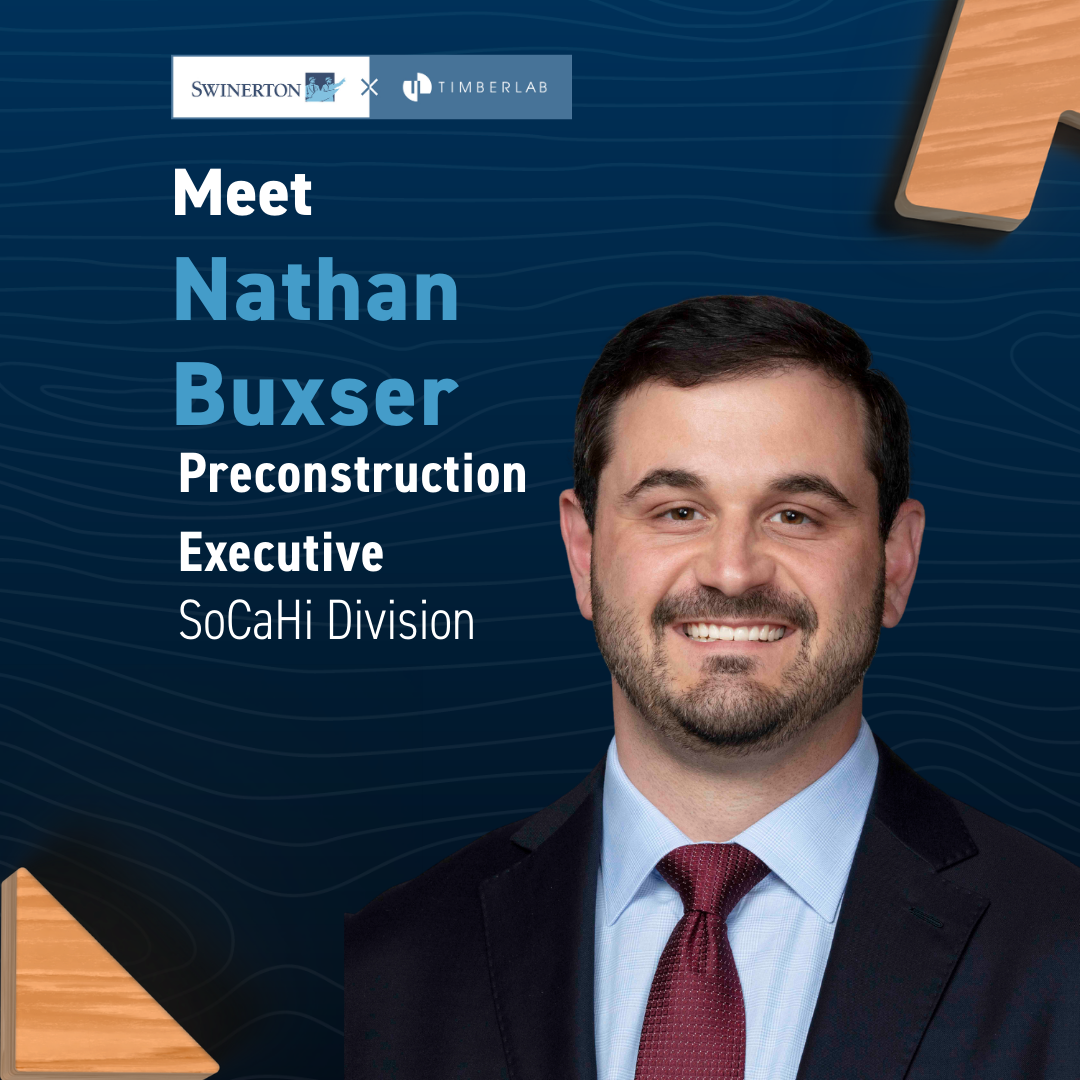
Nathan Buxser, Preconstruction Executive | SoCal and Hawaii Division
Nathan Buxser is a Los Angeles–based mass timber leader supporting Swinerton’s projects across all of Swinerton’s Core Markets.
Q: Where did you grow up, and where did you go to school?
I grew up in southwest Michigan and studied architecture at the University of Detroit Mercy, where I completed both my undergraduate and graduate degrees. That education really shaped the way I think. Architecture forces you to take something incredibly complex—an entire building—and break it into clear, manageable pieces. That habit of simplifying complexity has stayed with me throughout my career. It’s central to how I work today, especially when I’m helping teams arrive at holistic, balanced solutions.
Q: What is your background leading up to your career in construction?
I practiced architecture for 12 years and became a licensed architect in California before transitioning into construction. Leading large, multidisciplinary teams taught me early on that clarity, alignment, and consensus aren’t optional, they are the drivers of successful project delivery. Technical coordination is essential, but the differentiator is the ability to bring structural, MEP, civil, landscape, and specialty partners into one unified approach. That discipline and mindset built the foundation for how I lead in construction today, including how I approach supporting the work we do in the Los Angeles architecture community, as well as Southern California and Hawaii.
Q: What has been your career path?
My path moved from architectural practice into design management when I joined Swinerton, and today my role is focused on advancing mass timber across our projects. The genuine, early integration that mass timber requires is a natural extension of my background. Making mass timber buildings work requires teams to rethink design, construction, and even financial assumptions with fresh eyes. These projects aren’t “business as usual”; they require teams to reconsider how systems interact. In mass timber buildings, the systems aren’t isolated parts and pieces. The prefabrication required means coordinating structure, MEP routing, fire performance, acoustics, and moisture management as a single system. Helping teams do that, and lead with that mindset, has become the focus of my career.
Q: What were your first projects or job titles in the industry?
Before joining Swinerton, I followed a traditional architectural track, starting as a graduate architect and then becoming a project architect. I led the technical side of design teams, and I spent a lot of time in the field during construction administration, seeing how drawings actually translated into built work. There’s nothing quite as humbling or as instructive as walking a job with a superintendent who stops you, points up at something clearly wrong, and says, “So what was the plan for this, exactly?” Those early experiences were invaluable. They taught me that every line you draw has a consequence, and that good decisions come from understanding both the design intent and the realities of construction. That connection between design and construction, and my ability to understand both, still shapes how I approach my work.
Q: What led you to mass timber construction?
I first encountered mass timber in school. Glulams had been around for decades, but at that point CLT in the U.S. was still mostly theoretical. I even used it in one of my studio projects because of the richness it brought to the interior. My first real exposure, though, came after joining Swinerton, during an internal training session in Portland. Touring completed projects and hearing from the people who had delivered them was eye opening. That’s when I started to understand the precision, speed, and sustainability potential that mass timber offers. I believe it can deliver better buildings, and that belief led me into this focused role, helping teams adopt it at scale.
Q: What makes mass timber such a passion for you?
Mass timber has become a passion for me because it’s a vehicle for both collaboration and innovation. Its prefabrication and dimensional stability demand that architects, engineers, builders, and trade partners come together early and work toward a holistic solution that balances form, function, and cost across the entire building. That level of integration, and the ‘newness’ of the material, pushes teams to challenge assumptions. The solution that’s a foregone conclusion in a traditional structure might not work here, so a better one often emerges. And because the system is so coordinated, our use of VDC and digital twins actually becomes more powerful, helping teams lock in decisions earlier and translate that stability into real schedule and performance advantages.
Q: What advice would you give younger professionals entering this industry, and mass timber specifically?
Be curious and open. Ask “why?” often. Take advantage of the experts around you to look beyond what you already know. The deeper your understanding, the more innovative and impactful your contributions will be. Learning how to put a building together is important, but so is understanding the rest of the process. Mass timber succeeds when people understand the whole building, its individual components, and the processes and motivations of the teams delivering it.
Q: What makes the Swinerton–Timberlab partnership uniquely valuable for clients?
We’re a client-focused organization, and we aim to be true partners to project teams so owners can capture the full value of their investment. A big part of delivering that support is the dedicated horsepower we bring from design through construction. We use model-based estimating to iterate alongside the design team, bring in-house timber engineering and fabrication expertise, and pair it with field proven installation. Our investment in the Mass Timber Center of Excellence is raising our organizational IQ and strengthening our involvement in research and code development, which keeps us on the leading edge of the mass timber industry —work that directly benefits mass timber construction in Los Angeles as adoption increases, as well as in Southern California and Hawaii.
Q: How is mass timber evolving, and what trends are shaping its future?
Mass timber is moving from curiosity to mainstream. Codes are becoming clearer and more prescriptive, which is simplifying and accelerating adoption. The research we’re involved in will help shape future code cycles. Teams are getting better at optimizing systems rather than forcing traditional solutions to fit, and our understanding of whole building optimization, prefabrication opportunities, and connection design continues to mature. Supply chains are also stabilizing, and Timberlab is contributing through continued vertical integration. We’re not “done” with project conversions yet—we continue adding mass timber as an option and then helping teams optimize around it. Even when the outcome isn’t timber, the process is elevating design quality.
Q: Which types of projects are best suited for mass timber today, and where do the biggest opportunities lie?
Mass timber excels where long-term ownership, user experience, and sustainability matter—civic and public buildings, education, and office environments. Multifamily demand is growing as well, especially in markets where speed and density are priorities. Market interest is surging in Texas, California, and across the East Coast, while in the Pacific Northwest it’s treated as a more established part of the process. Financing has been challenging industrywide, but we’re seeing real inroads where timber provides strong alternatives, particularly in multifamily, as teams learn to leverage the system’s full benefits.
Q: How are Swinerton and Timberlab driving innovation across design, sourcing, digital construction, and project delivery?
That’s a big question, so let me break it down.
For us, innovation comes from integrating design, digital tools, fabrication, and field execution into one workflow. That alignment is what enables Swinerton and Timberlab to deliver mass timber with speed and certainty.
A lot of it starts up front. Model-based estimating lets us iterate with design teams in real time, and drone scanning helps validate sites and coordinate decisions early. That clarity is essential when you’re delivering a prefabricated system.
From there, we focus on turning early decisions into predictable execution. Our prefabrication strategies leverage mass timber’s precision to accelerate sequencing, like at Portland State University, where Timberlab installed 76 columns in a single day and follow on trades started immediately.
And we push the industry forward. We contribute to full-scale research and code development, advance connection technology— including the two hour, no hardware bearing connection at Heartwood— and invest heavily in training through our Mass Timber Center of Excellence so teams can deliver consistently as adoption grows.
Looking ahead, Los Angeles will continue to be a major growth market for mass timber construction, as well as Southern California and Hawaii.

