
Regional Mass Timber Spotlight
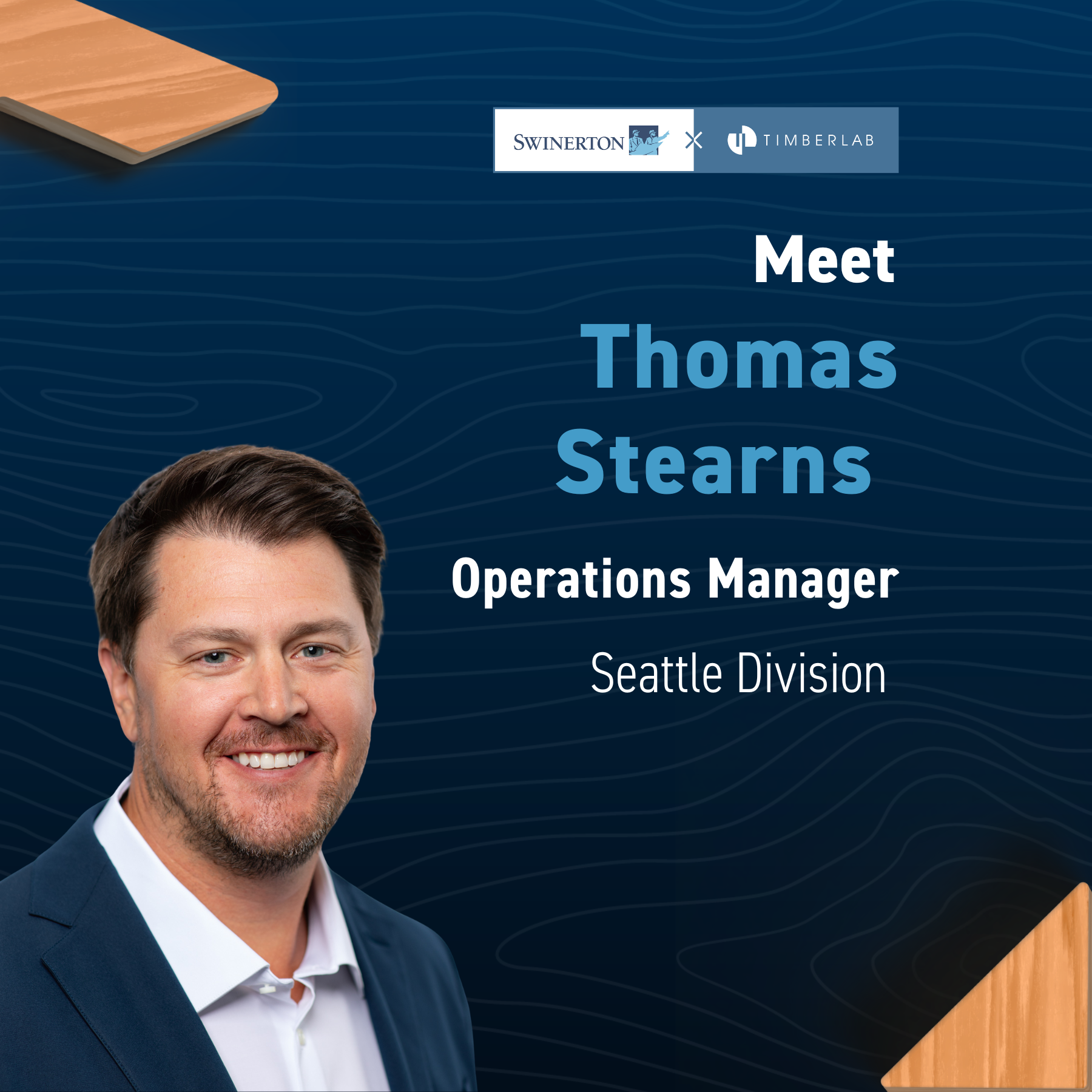
Thomas Stearns, Operations Manager | Seattle Division
Washington, the Evergreen State is defined by its lush forests and abundant greenery, and it comes as no surprise that mass timber construction has become increasingly common across the state and the Pacific Northwest—becoming a preferred building approach. Mass timber is nothing new to Seattle Operations Manager Thomas Stearns. Having delivered some of Seattle’s defining mass timber projects, Thomas and Swinerton’s Seattle team have become local experts for sustainable construction. With notable projects such as Northlake Commons and Heartwood Workforce Housing, Thomas has key insights into why mass timber is the premier sustainable construction method in Seattle and beyond and what sets the Swinerton-Timberlab partnership apart from competitors.
Q: Tell me about how you got into the construction industry.
My dad was a superintendent at a metal fabricating shop, was always working on projects around the house, and built a family cabin when I was young. I continually gravitated towards these types of activities and appreciated seeing the tangible results by watching things come together and solving puzzles. When I went to the University of Washington (UW), I discovered they had a Construction Management Program, and it was just a natural fit.
Q: Tell me about your early career and how it led you to Swinerton.
When I graduated from UW, I move to San Diego, CA and started my construction career. Not long after the 2008 recession hit, which slowed the industry down and prompted me to relocate to the Bay Area. It didn’t take long to realize the organizational culture wasn’t the right fit for me, and I found myself looking for something different. A former coworker had joined Swinerton and let me know of an opening. I met with the division manager and decided to make the jump to Swinerton’s Seattle division, drawn to the employee-owned culture, which better aligns with my own values. I have now been with Swinerton for more than eight years.
Q: What was your first mass timber project and how did you end up working on it?
I didn’t necessarily plan to work on mass timber projects, but in early 2020 the team needed support on a few mass timber preconstruction projects. What I immediately recognized and appreciated was how strong of a community there is between the different developers that were interested in mass timber and the designers and the engineers that were trying to figure out how to solve the complex equation of working mass timber into a project. I was lucky enough to work on several different projects with fantastic teams.
Q: What notable Seattle mass timber projects have you worked on, and how have they played a role in your growth in the construction industry?
My focus has been specifically on two projects that are very different: Heartwood, a workforce housing building, and Northlake Commons, an office/laboratory shell and core. Heartwood was very budget- and efficiency-focused, and Northlake Commons was a very high-end mixed-use building.
Northlake Commons really showcases the next generation of mass timber innovation in Seattle. Just across the street from a landmark Seattle lumber supplier, the design celebrates the neighborhood’s timber heritage while delivering the city’s first mass‑timber life sciences facility, an achievement made possible by the deep expertise the team brought to the timber procurement, planning, and constructability strategy. Delivering this building, now a Seattle mass timber landmark, while pioneering new mass‑timber safety solutions now adopted industry‑wide, showcases the strength of our expertise in bringing complex timber projects to life.
Similarly, Heartwood was a defining project as the first mass timber affordable housing building as well as the tallest CLT building in Seattle. During the project we had the opportunity to bring the Seattle Fire Department in for a tour to teach them about the fire testing with mass timber construction. Even after completion, this project still stands as a glowing example of the complexity and opportunity of mass timber.
From a growth perspective, these projects helped me realize that you can have really similar projects in the sense of site, structure, and logistics, while having big differences in project goals and priorities. That changed my perspective on how to approach a project, especially in preconstruction. It helped me see the big picture and really see and understand the different needs of a project.
Q: What sets Swinerton apart as a leader in mass timber?
I think one of the things that makes Swinerton uniquely positioned to be successful in mass timber is our commitment and dedication to this product type. Swinerton has made huge investments to create and grow Timberlab. The collaboration that happens from sourcing, manufacturing, and fabrication, all the way to site logistics and installation is best in class. I think the project that comes out of a Swinerton-Timberlab partnership is going to be of higher quality, get built more quickly, and cost less.
Q: Which markets do you see mass timber being used in the most and what markets do you think it would be successful in?
In the Seattle market, we are seeing mass timber in a lot of public projects such as schools, community centers, and libraries. I think that any market can benefit from mass timber, and we’ll continue to see that growth. There are different constraints to solve for, but they’re all solvable. Whether that be healthcare, industrial warehouses, or data centers, the carbon solution, amongst dozens of others that it provides, is going to really motivate a lot of owners to find ways to incorporate it into their construction and development plans.
Q: What does the future of mass timber look like in Seattle?
I think the future in Seattle looks very bright. There is going to be a need and a want, especially from institutional developers, to meet sustainability goals. Between government-mandated and corporate carbon reduction programs, I believe the use of mass timber will continue to grow. I also think we’re going to see a lot more growth in the industry in fabrication and manufacturing capabilities.
Q: Mass timber construction is becoming quickly more prevalent in Seattle. Why do you think that is?
If you look at Seattle, we have an abundance of forests. From a supply chain perspective, it makes a lot of sense to have manufacturers and fabricators close to their product. Wood construction is in the DNA of the people that live here, the people that work here, and the people that develop here. We are naturally drawn to incorporating natural elements into the spaces we build. Seattle has this desire for mass timber and environmental consciousness; we’re lucky enough to have plentiful resources surrounding us to support that.
Q: What are the benefits of mass timber construction?
One of the most obvious benefits of mass timber is the speed of construction. It is prefabricated; it goes together incredibly fast, and erection is less intrusive on the community. There are fewer labor hours on-site than a typical steel or concrete building which helps reduce the impact on neighbors, especially when you’re in tight, crowded urban areas. Costs can be very comparable when properly analyzed, and when the benefits are accounted for, this becomes a very attractive building type.
Q: Why are you passionate about mass timber?
There are a lot of reasons why I’m passionate about mass timber. A community that’s built with mass timber is a strong community. It’s healthier, it’s more aesthetically pleasing, and it’s more sustainable. Using a product that has a positive impact on our environment via decarbonization alone is worth getting passionate about. So many aspects of the construction industry can be viewed negatively, whether from environmental or community impacts. However, mass timber solves so many of those problems. As we look toward 2050 and beyond, it’s hard to imagine a world where you continue to solely build with concrete and steel because of the impacts. Mass timber allows us to be a bit more in harmony with the world around us and be able to build communities that are sustainable for the future.

