

Solving the Equation: Evidence for the Integrated Mass Timber Advantage
As a team, Swinerton and Timberlab deliver unmatched clarity, certainty, and problem-solving across the entire mass timber project lifecycle, proving why they are truly better together.
The Equation No One Else Can Solve
While mass timber construction has evolved from an innovative novelty to an increasingly mainstream building method, the complexity of successful implementation remains a significant barrier for most contractors. From sourcing, to fabrication, to risk, to installation, many in the industry operate with only a partial understanding of mass timber construction. Over the last decade, Swinerton and Timberlab have built one of the most comprehensive and diverse mass timber portfolios in North America, encompassing over 80 projects for a total volume of $1.3 billion.
Swinerton and Timberlab consistently demonstrate that success depends upon the ability to “solve the mass timber equation”—balancing design, sourcing, engineering, fabrication, and construction so that projects not only succeed, but maximize the inherent value of mass timber construction. The firms’ integrated approach transforms what many perceive as a risky, complicated process into a streamlined, predictable delivery method.
Operating seamlessly as full-service, trusted partners, Swinerton and Timberlab work with clients through every step in the construction process to address the fragmentation and complexities that stall other contractors. Together, the team creates the transparency and assurance that allow clients to move forward with confidence.
“The value of our partnership lies in the unmatched experience we bring. No one else in the industry has the depth of expertise we have, or can deliver projects with the certainty we can,” explains William Silva, Swinerton’s National Director of Mass Timber. “It’s really about a solutions-based, systems-integration approach: Timberlab deeply understands mass timber and the critical interface between building systems, and Swinerton knows the builder’s role and how to integrate structural systems.”
The result is a level of project clarity that fundamentally changes the mass timber conversation from Is this possible? to How quickly can we deliver?
A Different Way of Building
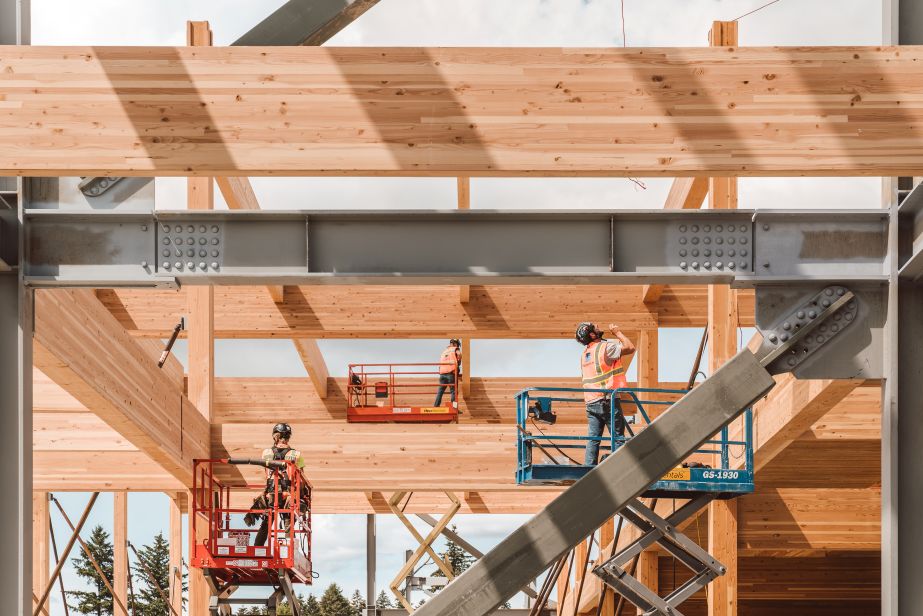
The construction industry’s traditional approach of assembling disparate specialists doesn’t always align well with mass timber projects. It creates silos with communication gaps, coordination challenges, contractual black holes, and compounding uncertainties that ultimately get passed on to clients through greater costs and extended schedules.
“From a client standpoint, the biggest risk is working with a general contractor who doesn’t fully understand how to implement mass timber alongside other systems,” notes Chris Evans, President of Timberlab. “That uncertainty often leads to inflated pricing because of perceived risk.”
One of the greatest mistakes contractors make is over-simplifying mass timber as a material swap from traditional concrete or steel.
In reality, mass timber buildings are a unique product type, designed and built as a “kit-of-parts” requiring a higher level of prefabrication compared to steel or concrete. Designs rely on a set of repeatable, pre-engineered components like beams, columns, floor panels, and connection details. These components are digitally modeled, engineered, and fabricated to precise dimensions offsite before they arrive at the jobsite labeled for installation.
This approach helps reduce waste, speed up construction, and use materials and onsite labor more efficiently.
However, the speed advantage only materializes when all structural, mechanical, engineering, plumbing, and building envelope systems are carefully planned before mass timber components are fabricated. Without this coordination, the potential benefits of mass timber quickly erode into trade coordination issues, cost premiums, and schedule delays.
Even if general contractors recognize that mass timber requires a specialized approach, successful execution is not guaranteed. Industry-wide barriers to adoption—such as fragmented supply chains, volatile sourcing challenges, and limited understanding of how mass timber structures integrate with the full building system—are the next challenges to overcome.
The Value of Supply Chain Integration
Swinerton has been successfully pursuing and delivering mass timber projects since 2016. Each project has been a learning laboratory, revealing the critical coordination points that determine project success. As demand for mass timber has grown, Swinerton recognized that mass timber delivery required a different operating model—one that allowed direct access to overcome supply chain constraints.
In 2021, Swinerton Incorporated launched Timberlab as a standalone business focused on accelerating mass timber adoption. The firm delivers capabilities beyond traditional construction, including custom glued laminated timber (glulam) and cross-laminated timber (CLT) fabrication, in-house timber engineering and design-assist services, and installation expertise and field coordination.
Most recently, manufacturing has become the natural next step in Timberlab’s evolution.
“Our approach has always been people and professional services first, not plants and equipment,” Evans says, noting a stark difference with competitors who have often led with facilities but lack experience. “We focused on understanding the supply chain—engineering, preconstruction, estimating, detailing—because those are the pinch points that make or break projects.”
By the time Timberlab’s CLT manufacturing facility opens in Millersburg, OR, in early 2027, Swinerton and Timberlab will have accumulated 10 years of experience and relationships. This reversed industry model is deliberate: build competence and then build capability, not the other way around.
Recently, Swinerton and Timberlab have taken this competency-based integrated approach even further with the creation of a National Mass Timber Center of Excellence.
Headed by William Silva, the entity works with both Swinerton and Timberlab to enhance outcomes and solve the equations for project delivery. By centralizing the firms’ collective expertise and leadership, the Center of Excellence will drive even better innovation and collaboration within project teams. The Center will provide resources and support to both Swinerton and Timberlab in removing barriers to mass timber adoption—especially those related to market-specific implementation or geographic differences in project delivery.
“Stepping into this national role is so enriching. As an employee-owned company, it allows us to leverage the strengths of each other, and everybody’s invested in mutual success and outcome,” Silva recently told Think Wood.
The Answer to the Mass Timber Equation
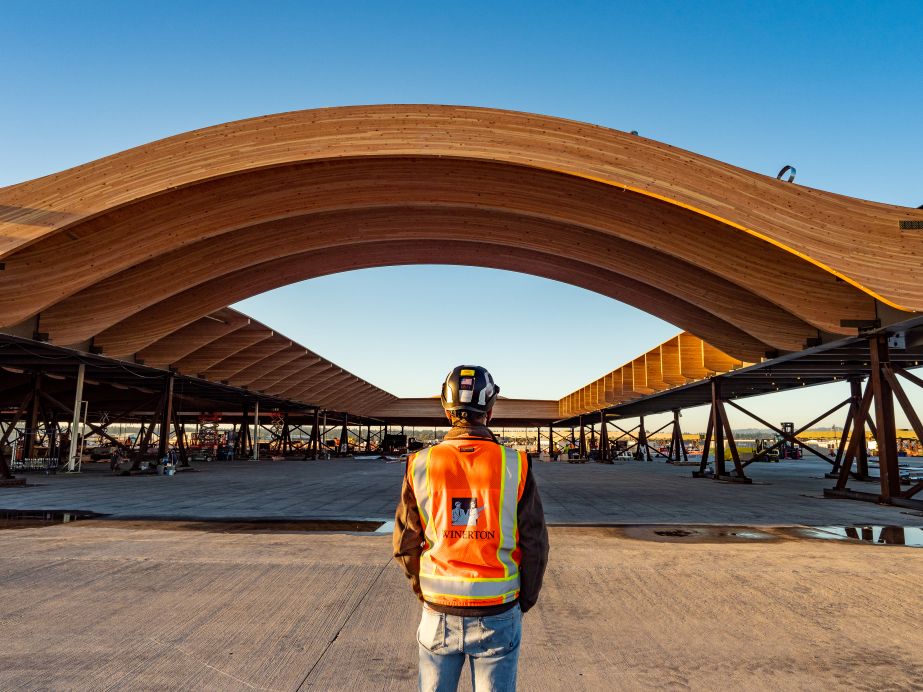
Mass timber is not inherently difficult for those who know how to work with it. As the most sophisticated team in the industry, Swinerton and Timberlab’s successful track record of over 80 projects creates an experience advantage that no other group can claim.
When clients have diverse motivators, including speed, sustainability, local impact, aesthetics, and wellness, it is imperative to have a team who can translate those goals into structural, procurement, and modeling decisions. The Swinerton and Timberlab team are able to deliver the desired outcomes with a level of certainty that is nearly unheard of for mass timber.
Additionally, the teams regular field experience in diverse geographies and market sectors creates opportunities in regions or applications where mass timber was previously considered impractical or cost prohibitive. In Southern California, a community college desired an unusual combination of light-gauge metal structural framing and wood-framed floors for a student housing project.
Preconstruction Executive Nathan Buxser explains, “The client felt like they couldn’t afford concrete, but wanted a higher quality than a traditional stick frame building. So we proposed to continue with the light gauge metal frame but instead of the framed floors we would do CLT.”
The result is a wood floor that will be exposed in all the dorm rooms and common areas, providing the warmth of mass timber for the students.
The answer to successfully solving the mass timber equation isn’t a trick detail or patented process. Instead, it is a perfectly curated balance of culture, vertical integration, supply chain maturity, engineering expertise, modeling investment, and collective experience. It relies on bringing in project experience, relationships built over time, and systems integrations—none of which can be purchased or quickly assembled.
This is where Swinerton and Timberlab stand apart as mass timber problem-solvers of the technical, market, and delivery equation—including all its nuances across regions, market sectors, and building types. In an industry where integration is often discussed but rarely achieved, Swinerton and Timberlab have built the comprehensive capabilities that transform mass timber from a promising concept into a reliable delivery method. This integration advantage proves why Swinerton and Timberlab are truly better together.
