
Regional Healthcare Lead Spotlight
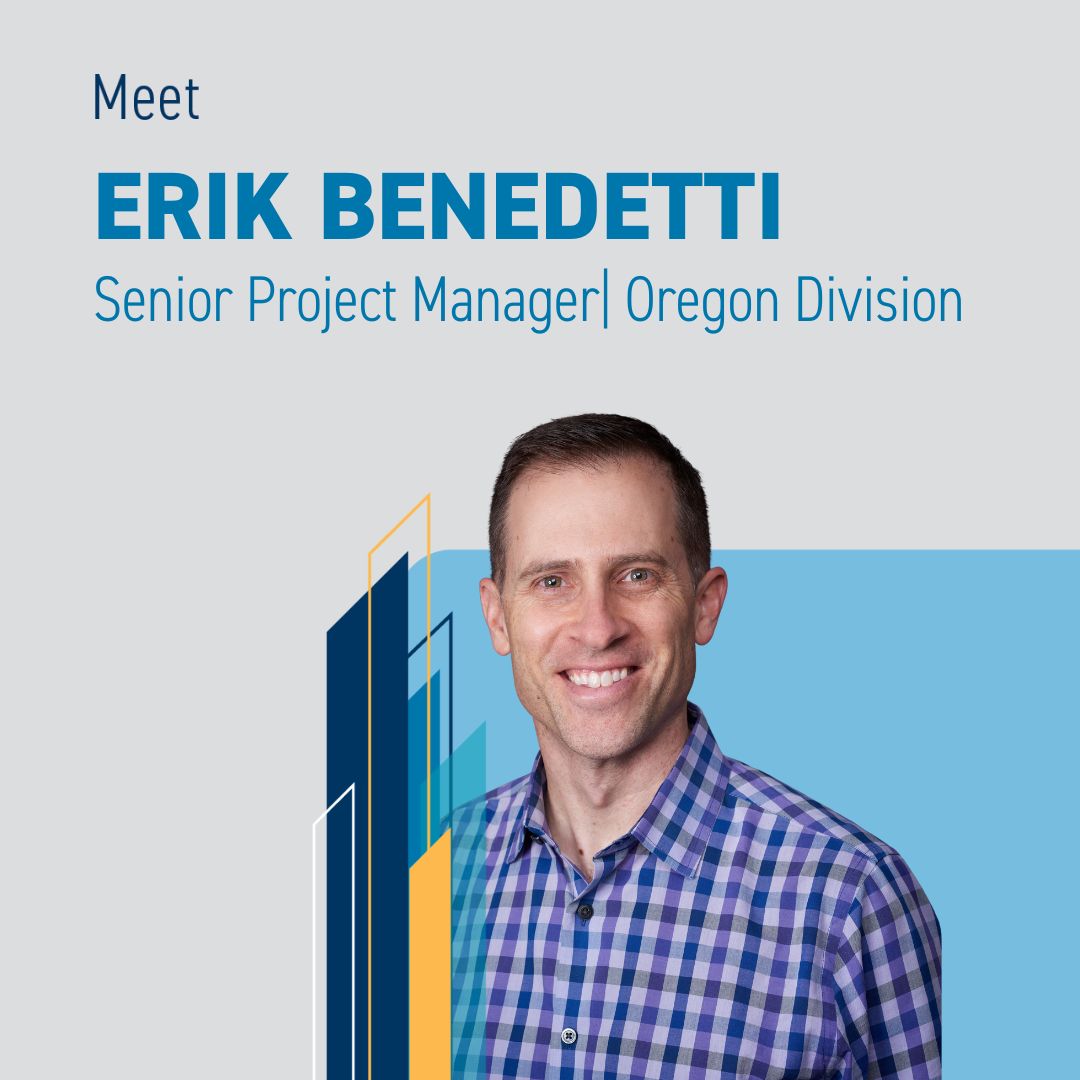
Erik Benedetti, Senior Project Manager, Oregon Division
As Swinerton’s Oregon healthcare market lead, Erik has spent the past five years spearheading some of the region’s most unique and complex healthcare projects. Working across Oregon and southwest Washington, Erik is not just expanding Swinerton’s healthcare footprint, he’s raising the bar on client experience, project delivery, and solidifying Swinerton’s reputation as a leader in healthcare construction in the Pacific Northwest.
A Career Built on Engineering and Service
Q: What is your background leading up to your career in construction?
I grew up in the Los Angeles area. I went to college at the Air Force Academy in Colorado Springs, Colorado, and majored in mechanical engineering. During my time in the Air Force, I worked in a space launch squadron, completed an MS in mechanical and aerospace engineering at George Washington University, and then taught in the engineering mechanics department at the Air Force Academy.
Q: What has been your career path?
My career has been a journey through diverse roles and geographies, each developing my expertise in healthcare construction. I moved to New York City after completing my service in the Air Force and began my construction career as a project manager for mechanical equipment and controls. That led to working as a mechanical subcontractor on healthcare and higher education projects. In 2015, I transitioned to general contracting work in California, focusing on healthcare and life science projects. I moved to Portland in 2019 and have been with Swinerton since 2020.
Finding Purpose in Healthcare Construction
Q: How did you find your way to healthcare construction?
When I first started in construction, I was looking for a way to build on my engineering degree while doing something that made a meaningful impact on the world around me. Early in my career, I had the opportunity to work on healthcare campuses, delivering critical projects to healthcare clients. As my career evolved, I was sought out more often for those projects. When I had the opportunity to really focus my attention and my career on healthcare, I jumped at that chance.
Q: How has healthcare construction become a passion for you?
I do feel like healthcare construction feeds the soul, because there’s something fulfilling about knowing the space you’re creating is going to help people in their time of need. I also love that these spaces usually have a lot of complexity. We have to coordinate around some very specific requirements, not only for medical equipment, but also for the care providers and the patients. Everything has to be right when it comes to complex interactions with the systems and operations in a hospital.
Swinerton’s Role as a Healthcare Construction Leader
Q: Would you label Swinerton as a leader in healthcare construction?
Absolutely. Our healthcare teams have set a high standard, bringing deep expertise and a successful track record of project experience. What makes Swinerton truly dynamic is how knowledge is shared across the company. Our dedicated team across the country operates as a unified network–able to tap firmwide resources, lessons learned, and specialized expertise. For the Oregon division and the Northwest region, this means we’re not building in isolation. We’re supported by, and we support a broader ecosystem that empowers us to pursue complex healthcare projects with confidence. It’s our collaborative structures that position Swinerton not just as a local or regional player, but a national leader in healthcare construction.
Q: What advice would you give to a young engineer who’s thinking about going into healthcare construction?
Healthcare projects are a great spot for a project engineer to add value to a team and grow. There are so many idiosyncrasies involved in healthcare that only the construction management team has the ability to influence. So, project engineers have a lot of responsibility right away, and they are working with the most highly trained and best folks in the industry.
The Complexities and Challenges of Healthcare Projects
Q: What are some obstacles that are unique to healthcare construction?
I think that every market has its own aspects that are challenging. I would say that, compared to some of the other projects I’ve worked on in different markets, healthcare has more stakeholders. In addition to the owner and design team, projects often have design-build subcontractors, deferred design elements, and multiple medical equipment providers. Also, the owner includes many different groups within the hospital or the healthcare organization, such as administration, doctors, nurses, other types of care providers, facilities, infection control, and environmental services. Swinerton views our role as the connecting thread through all these groups and accepts the challenge of organizing the information and requirements and coordinating the collective effort.
Q: What has been your most notable healthcare project?
The most challenging project I am currently managing is the linear accelerator upgrade at St. John Medical Center in Longview, Washington. We are increasing the shielding on a vault that is completely surrounded by an operational radiation oncology clinic that continues to provide care to cancer patients, many of whom are highly immunocompromised. We are performing significant structural, shielding, and MEP work in this extremely sensitive environment. The biggest challenge has been finding ways to carry out this complex work without disrupting patient care. Our team has approached this delicate balance by being technically precise and deeply compassionate.
Managing Construction in Active Healthcare Environments
Q: When working in active healthcare spaces, how do you navigate keeping not only your team and your project safe and on schedule, but also keeping patients and staff unaffected by the projects?
Healthcare construction is not a production-first type of construction. Every project at Swinerton has a safety-first focus, but healthcare projects have unique concerns, such as worrying about contaminants getting into the air and affecting people when they’re most physically vulnerable. We follow infection control protocols that are dictated by the type, duration, and location of the work. Since much of the work must take place in occupied facilities, it is always critical for us to have Infection Control Risk Assessment (ICRA) and Alternate Life Safety Measure (ALSM) plans documented and to be able to communicate the impacts of these plans to caregivers and other hospital staff. We emphasize these plans and protocols whenever we bring on trade partners, during our job site orientations, with construction signage, and with daily logs. Essentially, we have zero tolerance for violations.
Q: What are the challenges around installing large medical equipment?
The obvious answer is coordination of the complex requirements, but the real answer is schedule. Almost all medical equipment is installed by very specialized teams that travel to many different healthcare institutions, both in the US and sometimes even out of the country. Just like the production of the actual equipment, these teams are scheduled months in advance and have almost no flexibility. Making sure that everything is perfect for that installation date is critical. Part of what we do is make sure that the space we are working in has all the proper preparations, be it power, physical space, mechanical connections, or controls. We also consider the logistics of transporting that equipment into the space and how that might affect hospital operations. Swinerton works hand in hand with our clients and the medical equipment providers to make sure that we understand all the parameters required that day.
Looking Ahead: The Future of Healthcare Construction
Q: What do you see as the future of healthcare construction?
I think more healthcare institutions are looking for ways to deliver care to communities in the most efficient way. In many cases, that is an integrated healthcare model that brings the services closer to the communities being served. This includes ambulatory surgery centers, specialty care clinics, primary care clinics, and imaging clinics that are spread out from the single campus model. Delivering care facilities exactly where they’re needed gives Swinerton an opportunity to be a vital collaborator in defining how healthcare institutions will operate in the future. We need to continue to evolve and adapt as quickly as our partners in the healthcare industry.
Eric’s path from the Air Force to leading complex healthcare projects reflects the precision, discipline, and compassion that define Swinerton’s approach to building spaces that heal. His dedication to collaboration and technical excellence continues to strengthen Swinerton’s position as a trusted healthcare construction partner across the Northwest and beyond.

