
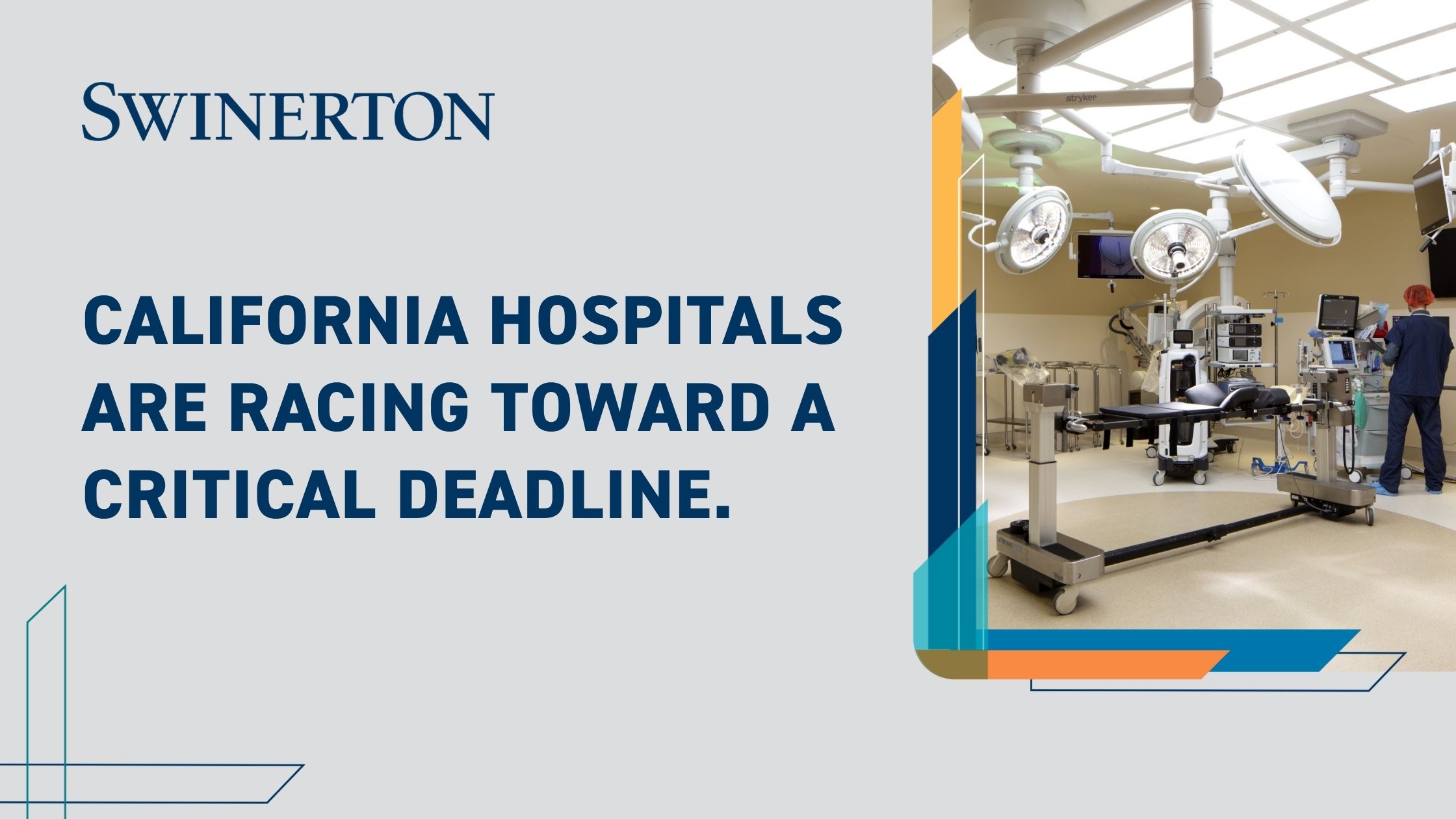
California Hospitals Face 2030 Deadline: Seismic Safety Law Driving Major Upgrades
California’s vulnerability to earthquakes is no secret. But what happens when a hospital—our most critical lifeline during a disaster—isn’t built to withstand the shaking?
That’s the driver behind Senate Bill 1953 (SB1953), a landmark law passed in 1994 following the devastating Northridge earthquake. The legislation mandates that all general acute care hospitals in California meet stringent seismic safety standards by January 1, 2030—not only to survive an earthquake but to remain fully operational during and after one. [Source]
Why California’s Seismic Safety Laws Matter
Building on the Alfred E. Alquist Hospital Seismic Safety Act of 1983, SB1953 outlines two critical milestones:
- By 2025, hospital buildings must be retrofitted or replaced to prevent collapse.
- By 2030, facilities must be capable of continuing operations after an earthquake.
[Source: infrainsightblog.com]
To meet these requirements, hospitals must achieve SPC 3+ (Structural Performance Category) and NPC 5 (Non-Structural Performance Category), which encompasses systems such as power and water. [Source: infrainsightblog.com]
The 2030 Compliance Challenge for Hospitals
Hospitals across California, particularly in rural and aging urban areas, face significant challenges. According to the California Department of Health Care Access and Information (HCAI), only 45% of hospitals statewide are currently on track to meet the 2030 compliance deadline. Many facilities were built decades ago and now require extensive retrofitting or complete replacement. The estimated statewide cost? A staggering $143–176 billion, according to the RAND Corporation. [Source: hconews.com]
What’s at Stake for Communities
Failure to meet SB1953 requirements could result in hospitals losing their licenses to operate acute care services. The implications are serious:
- Reduced access to emergency care
- Longer travel times for patients
- Increased strain on compliant neighboring hospitals
This is especially critical for rural communities, where hospitals often serve as the sole source of emergency and acute care.
[Source: calhospital.org]
How Hospitals Are Responding
Healthcare systems are adopting a range of strategies to meet compliance:
- Retrofitting existing buildings where feasible
- Constructing new facilities designed to meet or exceed seismic standards
- Phasing upgrades to minimize disruption to patient care
[Source: cumming-group.com]
Some organizations are also advocating for legislative relief, including deadline extensions and financial support for smaller hospitals. However, recent efforts—such as SB 1432, which proposed extending the 2030 deadline—were vetoed by Governor Newsom.
[Source: calhospital.org]
What This Means for Communities
Seismic compliance is more than a technical requirement—it’s a public safety imperative. Hospitals must be ready to serve during the very disasters that threaten their infrastructure.
Communities can play a vital role by:
- Staying informed about local hospital compliance plans
- Supporting funding initiatives that prioritize seismic safety
- Engaging with hospital leadership to understand potential service impacts
Swinerton’s Role in Healthcare Seismic Upgrades
Swinerton brings deep expertise and a proven track record in seismic upgrades for healthcare facilities, helping clients navigate the complexities of SB1953 compliance ahead of the 2030 deadline.
With over 20 years of experience in California’s seismic regulations and in healthcare construction, Swinerton delivers innovative, cost-effective solutions that prioritize patient safety, operational continuity, and regulatory compliance. Our integrated approach—leveraging advanced BIM technology, strategic preconstruction planning, and collaborative delivery models—minimizes disruption to hospital operations while meeting or exceeding seismic standards.
Swinerton provides early cost estimates and construction schedules, highlighting potential operational impacts, to help hospital systems evaluate seismic upgrades versus full replacement. Unlike traditional construction projects, seismic upgrades begin with structural retrofit requirements, not architectural design—requiring a unique and methodical approach.
Swinerton’s Northern California Healthcare Project Executive Nick Palumbo shares,
“We’re successfully working on seismic upgrades and retrofits for nearly every major healthcare system from Santa Cruz up to Grass Valley and down to the Central Valley and have been doing so for the past nine years—primarily partnering with structural engineers like Buehler and Degenkolb. We have a solid breadth of lessons learned, processes, and experienced professionals to offer our clients.”
Featured Seismic Projects Across California
Across California, Swinerton has partnered with leading healthcare systems to deliver seismic retrofit and new facility projects that strengthen hospitals’ resilience, meet SB1953 requirements, and safeguard patient care. Each project showcases Swinerton’s integrated approach- combining preconstruction precision, BIM-driven coordination, and phased execution within occupied acute-care environments. From Los Angeles to the Bay Area, these projects exemplify how Swinerton helps healthcare clients achieve compliance without compromising operational continuity or patient safety.
- Dignity Health California Hospital (Los Angeles): Swinerton constructed a new 145,000-square-foot acute care tower, seamlessly integrating it with the existing hospital and expanding emergency and critical care capacity—all while preparing the facility for future seismic events and compliance.
- Dignity MGH Emergency Department Intake Remodel (CommonSpirit Health): Delivered a 4,500-square-foot emergency department upgrade, focused on safety, efficiency, and minimal operational impact.
- Dignity Health MTCAP (Materials Testing and Condition Assessment Program): Swinerton managed this program across 10 Northern California campuses, overseeing 22 HCAI permits for materials testing and assessment to achieve SPC-4D seismic compliance by 2030. Covering over 1.5 million square feet of acute care space, the program standardized processes and documentation, with Swinerton self-performing key scopes such as framing, drywall, demolition, and concrete. All work was completed in occupied spaces with strict ICRA-ISLM protocols, delivering projects under budget and ahead of schedule.
- Seton Hospital Seismic Upgrades (Daly City): Swinerton delivered seismic upgrades at Seton Medical Center, an occupied acute care hospital, through a phased infrastructure approach. The scope included equipment anchorage, fire sprinkler and utility bracing, new and upgraded structural beams, and ADA improvements to 36 bathrooms. Customized phasing minimized disruptions to patient care, while the team managed unforeseen utility issues and adjusted schedules to meet clinical needs and maintain project momentum.
- John Muir’s Seismic John Muir Health Expansion and NPC 4 Seismic Upgrades Swinerton provided general contracting services for John Muir Health’s Phase Three and Four Interior Renovation Program at the Walnut Creek Medical Center campus. This program consists of eight concurrent projects within the 1984 “Phase Three” and 2012 “Phase Four” buildings. The projects address strategic and operational goals, end-of-life system updates, regulatory compliance, modernization of services and equipment, and workflow efficiencies. Each project is independently designed and permitted by OSHPD but interrelates with the others in terms of scheduling, logistics, and patient impact. The scope includes renovations and upgrades such as Labor and Delivery Renovation & NPC 4 Upgrades, Operating Room Expansion & NPC 4 Upgrades, Respiratory Therapy Renovation, Endoscopy Suite Expansion, Voluntary SPC Upgrade/Seismic Improvements, SPD Elevator Equipment Modernization, Sterile Processing Department Renovation, and OR Lights, Booms, and Monitor Replacement. The project involves multi-phased hospital work in an occupied, acute care environment, requiring detailed coordination across concurrent projects.
Looking Ahead: Building a Resilient Healthcare Future
With just over four years until the 2030 deadline, the pressure is mounting—but so is the opportunity. California has a chance to build a more resilient healthcare system that protects lives when it matters most. Hospitals are rising to the challenge. And with continued collaboration, innovation, and community support, they can meet it head-on.
Need SB1953 compliance support?
Swinerton helps healthcare systems meet California’s seismic standards with minimal disruption to their operations. Contact Us ->

