
Mass Timber Buildings: A New Approach to Sustainability and Net Zero Goals
Mass timber is rapidly gaining momentum as a preferred building material among owners and developers seeking practical solutions to achieve net-zero carbon goals. Whether they are leaning on public-private partnership (P3) or traditional delivery methods, owners and developers are recognizing the benefits of wood as a versatile, sustainable, and structurally efficient feature for their projects. With public and private support for this renewable resource, mass timber is increasingly competing with steel and concrete across a growing range of building types.
“Mass timber offers cost and value considerations that developers and clients see as benefits. Mass timber supports regional economies, saves time on the speed of construction, and is a renewable resource—with the added benefits of improved daylighting and interior aesthetics, which benefits the health and well-being of the end-user as well,” said William Silva, Director, National Mass Timber.
For example, at Northlake Commons, the utilization of mass timber estimates 1,990 metric tons of avoided CO2e (carbon dioxide equivalent) emissions, with a total carbon benefit of 2,920 metric tons, based on project-level life‑cycle analysis. This is equivalent to removing 558 cars from the road or to the energy required to operate 249 homes for an entire year. U.S. and Canadian forests sustainably regrow wood volume at a rate that replaces the material used in a mass timber project within minutes.
Swinerton’s early commitment to mass timber began in 2016 with the design, permitting, and construction of the then largest mass timber office building in the U.S.—First Tech Federal Credit Union Oregon Corporate Campus—which was delivered four months faster and four percent cheaper than structural steel.
With more than 2,500 mass timber projects built or underway in the U.S. and the sector growing roughly 20 percent annually, mass timber continues to scale rapidly across commercial, institutional, and multifamily construction. Swinerton has assembled an unparalleled knowledge base and robust internal resources that are sought after by design teams and owners looking to capitalize on lessons learned across a growing portfolio of projects.
While building designs will continue to push toward net zero energy, reducing operational carbon through better energy efficiency and cleaner energy sources, there is growing policy and regulation emphasizing the importance of reducing the embodied carbon of our infrastructure as well. Structure and foundation make up over half of a building’s embodied carbon footprint, so they are often targeted first for reductions. Every metric ton of wood used in place of concrete and steel in the structure is estimated to avoid 3.9 metric tons of CO2 emissions, and this is compounded by the fact that mass timber buildings are lighter and reduce the carbon (i.e., concrete) in the substructure.
Life-cycle assessment (LCA) is the industry tool for evaluating the embodied impacts of a building design, but what it cannot account for is the potential carbon “storage vault” mass timber infrastructure offers cities. Mature forests are maximizing their carbon storage, while growing forests are maximizing their carbon sequestration. By sustainably harvesting trees off the landscape and storing that carbon in wood structures for the life of the buildings, forests are allowed to sequester carbon more rapidly from the atmosphere and avoid releasing a large portion of the carbon stored in the removed trees.
While the softer benefits of mass timber, sustainability, and aesthetics frequently lead project teams to want to use a mass timber solution, the construction benefits are often what enables them to happen.
Swinerton recognizes the challenges of developing a project around a new structural system and brings its expertise to teams seeking creative solutions to make a mass timber project financially viable. Swinerton’s approach is to direct efforts toward reducing overall construction cost through smart and informed selections of not just the structural system but also to look at how to leverage complementary benefits in building mechanical, electrical, envelope, and interior systems to help achieve low energy goals.
“We can control costs through early assessment on project alignment with building code and efficient structural layouts that allow for complementary benefits with other building systems and maximize prefabrication,” added Silva.
Because Swinerton is a national leader in numerous construction market sectors, it combines market sector knowledge with mass timber advantages to bring beneficial outcomes for its clients. Swinerton has pioneered mass timber solutions in market sectors, including affordable housing, aviation, civic, community college, corporate accounts, healthcare, higher education, life science, office and more.
5 Examples of Swinerton’s Mass Timber Project Experience
Northlake Commons, Seattle, WA
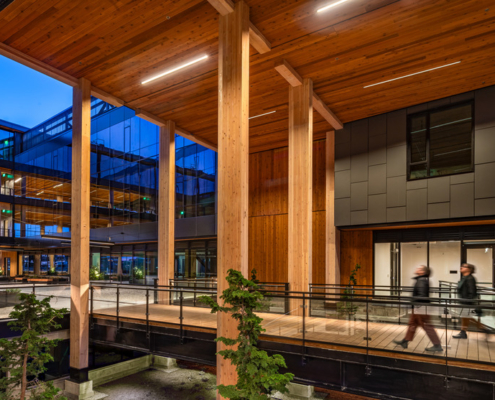
Swinerton’s Northlake Commons highlights the sustainability of mass timber in workplace construction. This 275,000-square-foot, LEED® Platinum-certified building incorporates mass timber columns, beams, and cross-laminated timber (CLT), showcasing how renewable materials can support both structural durability and environmental responsibility. Built in collaboration with Timberlab, a Swinerton affiliate, Northlake Commons’ timber was carefully chosen for its capacity to age beautifully while creating a warm, health-focused environment. Mass timber, significantly lighter than concrete and steel, reduces carbon emissions by up to 75%.
Beyond the use of wood, the building’s design maximizes water and energy savings, contributing to a 27% reduction in electricity usage and conserving over 700,000 gallons of water annually. Further, a significant 96% of construction waste was recycled, minimizing environmental impact. This commitment to sustainable mass timber not only enhances the building’s aesthetic and structural integrity but also reinforces Northlake Commons as a model for eco-friendly development in modern architecture.
Childcare Center, Boise, ID
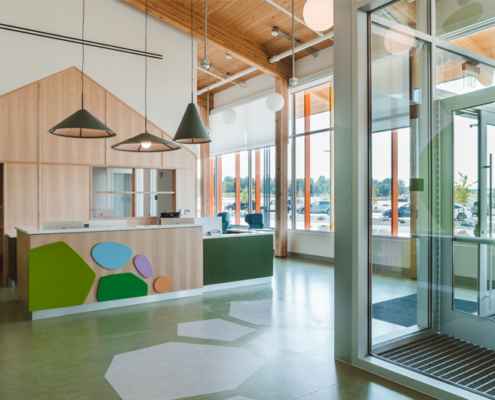
The new 19,347-square-foot single-story childcare center is a groundbreaking example of the benefits of mass timber in early education. Imagine nine lively classrooms with stunning vaulted ceilings, where clerestory windows flood the space with natural light, accentuating the warmth of timber columns and beams. Outside, timber overhangs create inviting play areas, blending seamlessly with nature.
This center isn’t just beautiful—it highlights sustainability. It combines mass timber with additional eco-friendly exterior materials, native landscaping, and cutting-edge energy-efficient features like low-VOC paint, smart thermostats, and LED lighting, seeking to achieve LEED® Gold certification. This innovative approach ensures a healthy, inspiring environment for children to learn and grow.
Sunnydale Community Center, San Francisco, CA
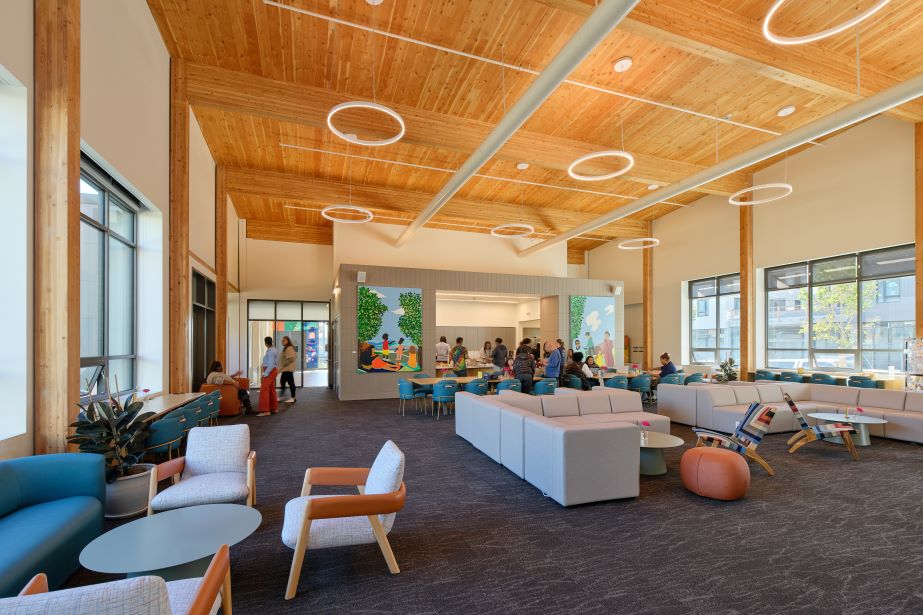
The Sunnydale Community Center, known as ‘The Hub,’ is a vibrant new 30,000-square-foot, two-story mass timber facility at the heart of the redeveloped Sunnydale HOPE SF neighborhood. Serving as a gateway into McLaren Park, the center offers a mix of spaces including a teaching kitchen, study areas, a recording studio, and a living room for community gatherings. The building also provides new facilities for Boys & Girls Clubs of San Francisco and Wu Yee Children’s Services, significantly expanding their capacity to deliver industry leading childcare and youth programs.
Designed for LEED® Gold certification, the center emphasizes sustainability and biophilic design, utilizing cross-laminated timber (CLT) and glue-laminated timber (glulam) for their structural, aesthetic, and eco-friendly qualities. The exposed wood structure accelerates construction, reduces waste, and creates a warm, inviting atmosphere. Mass timber brace frames and exposed beams are showcased throughout, allowing for open, light-filled spaces and demonstrating the structural capabilities of mass timber.
This project revitalizes the neighborhood, highlighting the possibilities of mass timber construction and Swinerton’s commitment to environmental responsibility and community impact.
Live Oak Bank Building 4, Wilmington, NC
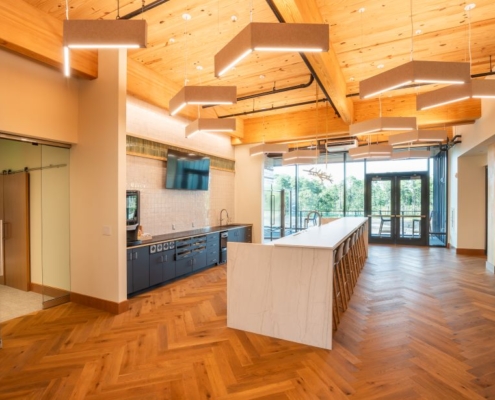
In Wilmington, NC, Live Oak Bank Building 4 now stands as the region’s first fully mass timber office building. This four-story, 67,000-square-foot structure is one of the largest of its kind in the United States, reducing the building’s carbon footprint by up to 60%. The project showcases the combined expertise of Swinerton and Timberlab, featuring cross-laminated timber and glue-laminated timber components prefabricated at Timberlab’s new Greenville, SC facility using Southern Yellow Pine. Set on 100 acres of coastal landscape and overlooking an expanded pond, the building blends nature and innovation, maximizing biophilic design to foster a healthier, more productive environment for over 320 Live Oak Bank employee-owners. Leveraging advanced VDC technology and close coordination, the Swinerton and Timberlab teams delivered the project six months faster than traditional methods. Live Oak Bank Building 4 is on track to achieve LEED® Silver certification, underscoring its commitment to sustainability and eco-friendly design.
For a deeper look at how Swinerton and Timberlab overcame coordination challenges on this milestone project, visit An Expert Approach to Coordination Challenges.
Responsive Arts & STEAM Academy, Denver, CO
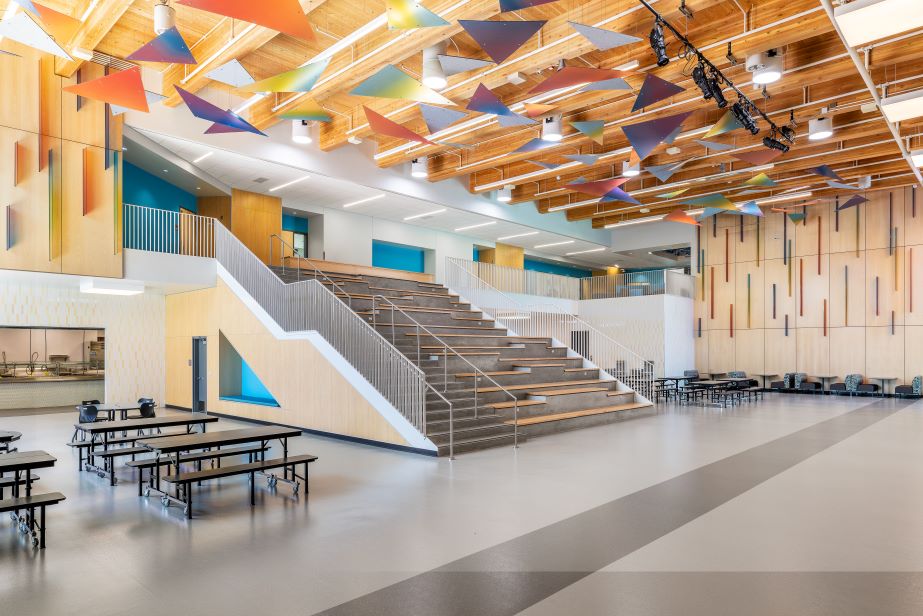
The Responsive Arts & STEM Academy in Northeastern Denver now stands as a completed benchmark for sustainable educational design. As one of Colorado’s first all-electric hybrid mass timber schools and a pioneering project for Denver Public Schools, the academy exemplifies the district’s commitment to its climate action plan. Every aspect of the facility—including heating, cooling, and kitchen systems—was constructed to meet rigorous environmental standards.
The finished school features striking mass timber beams and columns in its commons and gymnasium, showcasing both aesthetic excellence and a strong commitment to sustainability. By utilizing cross-laminated timber (CLT) in these key spaces, the project team eliminated the need for long-span steel joists, which typically require a lead time of more than nine months. This innovative approach not only accelerated the construction schedule but also delivered a vibrant, welcoming environment that supports student learning and well-being. The Responsive Arts & STEM Academy now serves as a model for future educational facilities seeking to combine environmental responsibility with forward-thinking design.
Additional Reading: Contractors are Partners for Achieving Sustainable Development Goals

