
Racing the Runway: How Swinerton Built San Diego Airport’s 5,230-Space Parking Solution While Planes Kept Flying
The two-phase Terminal 1 Parking Plaza caps a decade-long transformation at one of America’s most space-constrained airports—and offers a blueprint for infrastructure projects that can’t afford downtime
When San Diego International Airport opened the second phase of its Terminal 1 Parking Plaza in September, completing a 2-million-square-foot structure with more than 5,200 parking spaces, it marked the culmination of a high-wire construction act that few travelers racing to catch flights will ever fully appreciate.
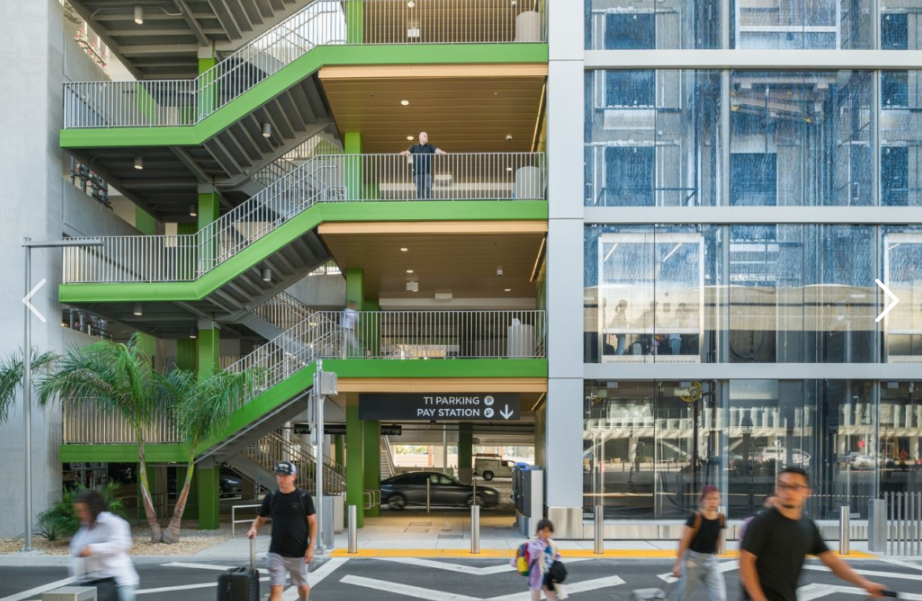
Built adjacent to an active international airport while simultaneously coordinating with a massive terminal redevelopment, the five-story parking plaza represents both a logistical triumph and a strategic bet on changing traveler behavior. With 185 electric vehicle charging ports, camera-based space detection, and stormwater recapture systems, the facility is less a utilitarian concrete box than a statement about what modern airport infrastructure needs to be.
For Swinerton, the San Francisco-based builder that delivered the project through a design-build partnership, the parking plaza also represents a homecoming of sorts. The company built the airport’s Terminal 2 garage in 2016, giving them institutional knowledge that proved invaluable when tackling an even more complex project in a tighter footprint.
“We learned a lot previously when we did that one back in 2016,” says Jeff Goodermote, vice president and division manager at Swinerton. “We went into it knowing or believing to know the airport and their stakeholders and their complexity and the depth of their team. And then [during] this round, they added another layer on top of that.”
For context, before 2016, San Diego International relied primarily on surface parking. The transformation to structured parking has been nothing short of dramatic, effectively quadrupling close-in capacity over the past decade.
Design-Build as Risk Mitigation
Perhaps the most significant strategic decision wasn’t about the parking plaza itself, but how it would be procured. The airport selected design-build delivery—a method that integrates design and construction under a single contract—rather than the traditional design-bid-build approach that dominates public infrastructure projects.
“Delivering these jobs under design build delivery just from day one fosters this environment of collaboration, and communication, and gets the whole team working together versus creating friction, and adverse relationships amongst the different parties, and the different stakeholders in the project,” Goodermote says. “I do attribute a lot of success to this job [to] the airport’s decision to deliver the job under a design build delivery, because that just sets the tone of the job.”
That collaborative approach proved essential given the project’s complexity. Swinerton wasn’t just building next to an active airport; it was building as part of a massive Terminal 1 master development that included roadway reconfigurations and access changes. The airport itself brought substantial internal project management capacity, with multiple operating groups and stakeholders that needed coordination.
“I actually encouraged our teams, the more engagement we can get from the client, the better, because it ultimately gives a better end product without having to go back and redo things,” Goodermote says.
Engineering the “Plaza” Experience
The airport’s insistence on calling the facility a “parking plaza” rather than a garage or structure reflected genuine design ambition. Working within tight budget constraints, the team found ways to elevate the experience beyond the standard concrete box.
“I think something that makes this truly unique stems from really the airport calling it a parking plaza and this theme that it’s more than than a big box,” Goodermote says. “They really value that investment of dollars. They integrate public art into these facilities. They want to make this an inviting space to the traveling public.”
The design incorporates strategic light wells that serve multiple functions: they provide natural ventilation and wayfinding for pedestrians while also serving as seismic expansion joints, reducing costly infrastructure while improving aesthetics. Color-coded vertical circulation cores—elevators and stairwells—feature distinctive graphics and public art installations.
“The garages are designed with these light wells or breaks in the structures that provide not only pedestrian circulation to get from the structure, they align with the cores where the elevators and the stairs are, and provide these channels that get you to the airport,” Goodermote explains. “That provides an enhancement from a design standpoint, brings natural light into the building, but it also balances that cost and function because the size of these structures, we have to break them up from a seismic standpoint.”
The exterior features vertical fins that add visual interest while remaining economical—a repeatable system that avoided ballooning costs.
Technology as Sustainability Strategy
The advanced parking guidance system represents the cutting edge of lot management technology. Camera-based sensors monitor individual spaces, feeding data to digital signs at each drive aisle that display available spots. Red and green lights above each space provide instant visual confirmation.
“The ideal situation is you’re spending less time circulating. You’re getting to an open spot faster, which serves a couple purposes,” Goodermote says. “Number one, if you’re like me and you’re running late and you’re trying to get there, you can get to a spot quickly. But also going back to the sustainability aspect of it, by providing that mechanism where you can get to a spot faster, you’re reducing idle time and therefore reducing emissions.”
The system addresses one of parking’s most frustrating inefficiencies: the endless circling that wastes time and fuel while generating unnecessary emissions. For an airport serving millions of passengers annually, those small time savings compound into meaningful environmental and operational benefits.
Meanwhile, below the structure’s footprint, stormwater capture and reuse systems take advantage of the substantial “dead” real estate between foundation piers—roughly 40 to 50 feet of otherwise unusable space under the parking deck. The system prevents runoff into San Diego Bay while providing water for other airport operations, including feeding the central plant at Terminal 2.
The 185 EV charging ports—along with infrastructure upgrades to the Terminal 2 garage—position the airport ahead of California’s evolving vehicle electrification mandates.
“It was exciting to us at Swinerton that we actually as part of this job, not only did we add a substantial amount of electric vehicles in the Terminal 1 structure, but we actually upgraded the Terminal 2 structure and added EV stalls that when we built that one years back were put in for future expansion,” Goodermote says. “It’s really cool for us to come full circle of building something six, seven years ago for future expansion and then come back and actually be part of that future expansion.”
The Construction Juggling Act
Perhaps the most remarkable aspect of the project was what didn’t happen: major disruptions to airport operations or catastrophic delays.
“Construction is all about a communication business,” Goodermote says. “I really preach to people [that] we are very much in a people business and a communication business. The construction is a byproduct. But when you get in these tight logistics coordinating not only with us but being part of that master development that was being built for the whole T1, there were thousands of people out there working with hundreds of different companies and contractors, and we were only one piece of that.”
The first phase had more breathing room. But once that phase opened to the public in August 2024, the second phase construction site shrank dramatically. Swinerton was now building adjacent to both an operating airport and an operating section of their own parking structure, with constantly changing access routes as Terminal 1 roadwork progressed.
The solution came down to military-grade planning: proactive coordination with subcontractors, carefully timed deliveries to avoid passenger traffic, and continuous communication across multiple contractor teams working on different elements of the Terminal 1 master plan.
“It really just comes down to construction logistics,” Goodermote says. “The first phase kind of had a little bit more real estate to play with. Once we opened that, we are now adjacent to an operating parking structure. Our logistics, the amount of real estate we had around the second phase, shrunk down drastically.”
The Local Impact
For Goodermote and his team, there’s particular satisfaction in delivering infrastructure that serves the local community. Unlike terminal buildings—which host both local travelers and visiting passengers—airport parking is used almost exclusively by local residents.
“I think for us taking a little bit more pride in building a piece of infrastructure that is truly for the community and used by us,” he says, noting that Swinerton has a substantial San Diego presence with many employees who travel through the airport.
The unsolicited feedback has been consistently positive. “I inherently get a lot of feedback from them,” Goodermote says. “What I hear constantly is just the ease of navigating through the structure, of being able to get in seamlessly, find a spot and get out. And then also as you’re arriving back at the airport is the ease of navigation.”
With the Terminal 1 Parking Plaza now complete, San Diego International has transformed from an airport with limited close-in parking to one with nearly 8,500 spaces serving two modern terminals. For travelers, that means shorter walks and less time circling for spots. For the airport, it means recaptured revenue and enhanced competitive positioning.

