
Regional Mass Timber Spotlight
The Return to Timber: William Silva’s Journey to National Mass Timber Leadership
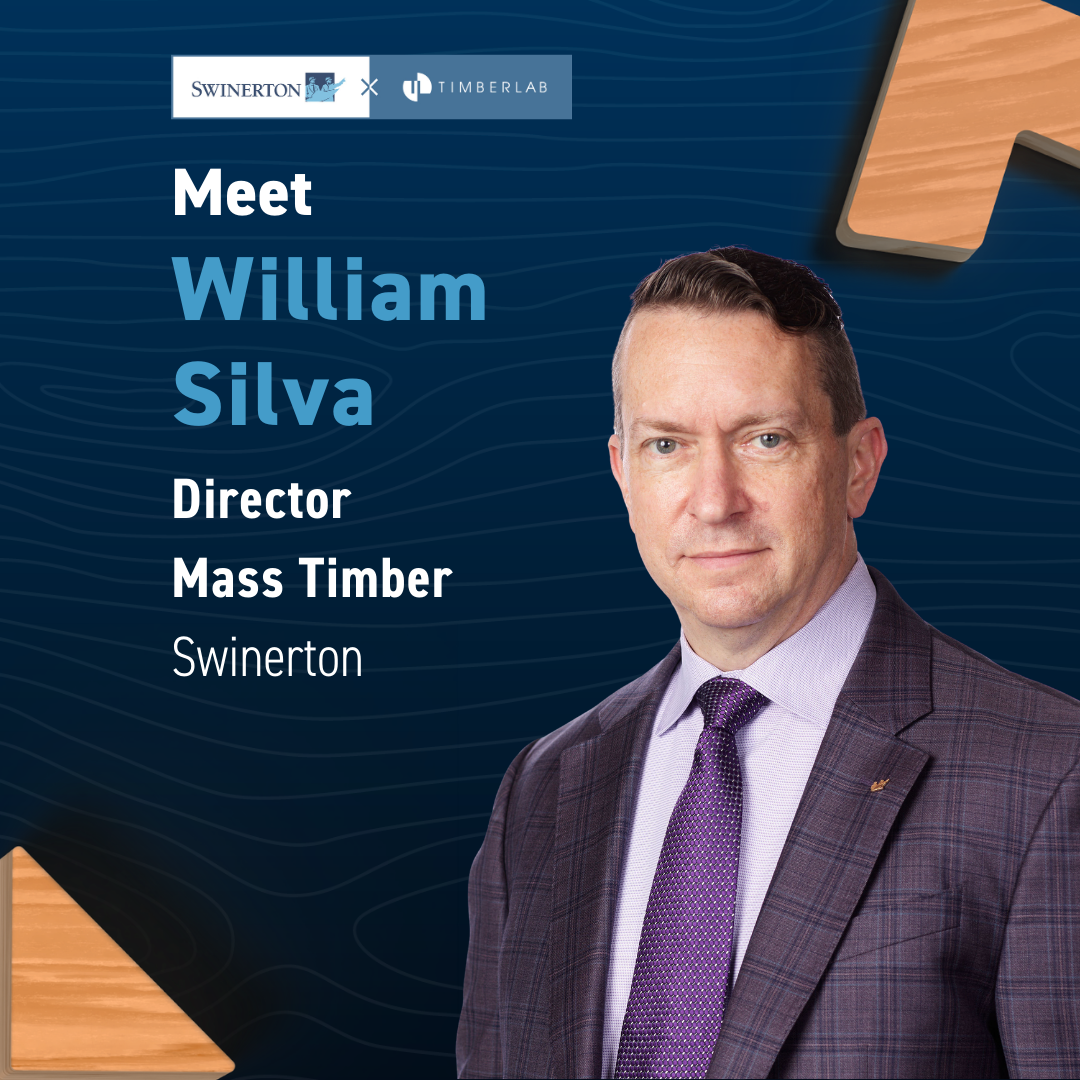
When Swinerton announced William Silva as its new Director, National Mass Timber, it marked more than a strategic leadership move. It signaled the company’s continued commitment to shaping the future of mass timber. With more than 30 years in construction and nearly 15 years at Swinerton, Silva has become one of the most influential figures in the mass timber community.
However, Silva’s connection reaches back far earlier than his professional career or his first mass timber project.
It began with a photograph.
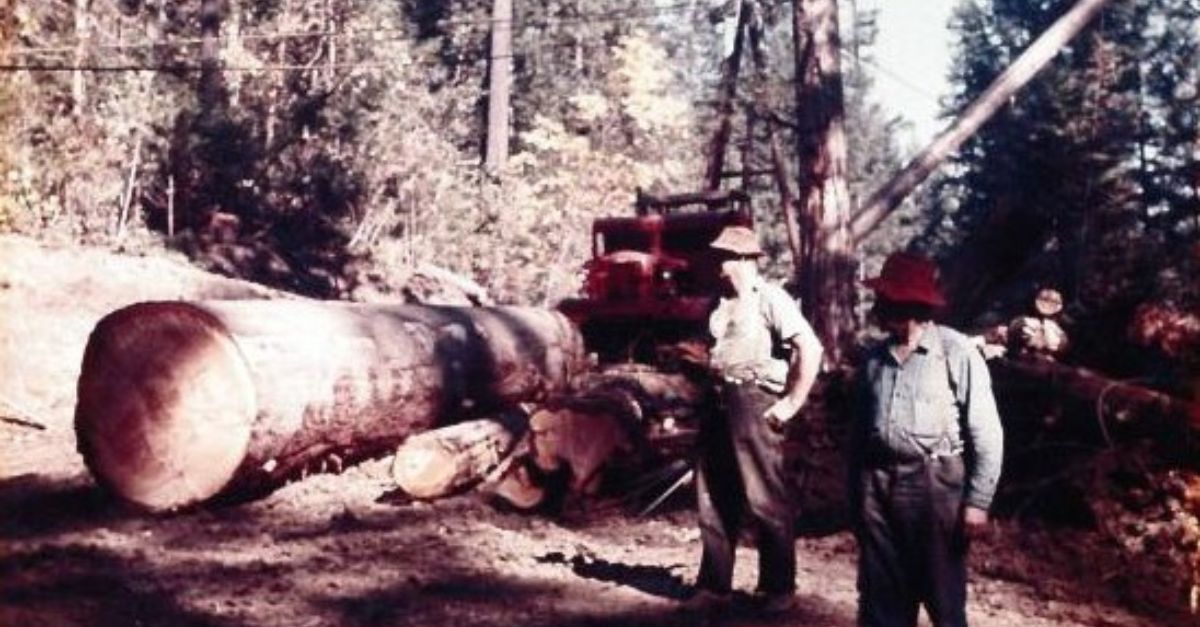
Years ago, Silva’s grandmother handed him a nostalgic image of his grandfather and great-uncle as young men in Grants Pass, Oregon, standing tall beside the massive Douglas-fir logs they harvested. The image, a powerful reminder of the rugged timber heritage that helped shape Southern Oregon in the mid-century years, and for Silva, the four generations before him who worked in the forest industry. Timber wasn’t an industry—it was a way of life. A source of identity.
Born in Grants Pass, Silva grew up in Portland, Oregon, far from the sawmills and forests that supported earlier generations of his family. Yet as he looks at where his career has taken him—mass timber advocacy, innovation, and leadership—he wonders if his father would have predicted the inherent boomerang effect—a return, not by geography but by calling. Silva has found himself leading the most influential mass timber construction group in the country.
“I sometimes think this work was always in my DNA,” he reflects. “That photo reminded me: I’m a part of the timber ecosystem. I just happened to come back to it in a different capacity.”
How First Tech Became a Catalyst for the Future of Mass Timber
Silva’s step into timber came in 2016, on the First Tech Federal Credit Union‘s new Oregon campus in Hillsboro, Oregon, where a question changed the project trajectory and kick-started an industry transformation: Why not mass timber? Choosing timber over steel and concrete aligned with the client’s people-first values and created a workspace that connected to the natural environment.
It also presented a bigger possibility, one that Silva and Chris Evans, now president of Timberlab, believed could position Swinerton as the industry’s mass timber leader.
The two drafted a business plan for what would become Swinerton Mass Timber. At the time, mass timber was still new to the U.S. market, but Silva and Evans immersed themselves in fully understanding all the challenges and opportunities of the emerging system by self-performing it. The team leaned into design-assist with mechanical, electrical, and plumbing partners, advanced prefabrication, and co-designed a cost-efficient frame solution with the engineer of record.
It worked. In less than 12 weeks, a 156,000-square-foot, five-story structure rose 4% cheaper and four months faster than structural steel, a clear signal to owners, developers, and agencies that mass timber could deliver certainty, speed, and beauty at scale.
Inside Swinerton, that performance catalyzed the formal launch of Swinerton Mass Timber, a pivot that helped spark the future of mass timber in the U.S and would eventually evolve into the unique, fully integrated Swinerton x Timberlab model employed to solve the mass timber equation for diverse clients and vertical markets throughout the U.S. today.
Innovation and Leadership Emerges from the Unfamiliar
If First Tech was the inflection point, Hidden Creek Community Center was the supply chain stress test. The Hillsboro, Oregon, facility required Swinerton to procure cross-laminated timber (CLT) and glue-laminated timber (glulam) from several manufacturers and fabricators, as the supply chain was undergoing dynamic shifts amid increased demand.
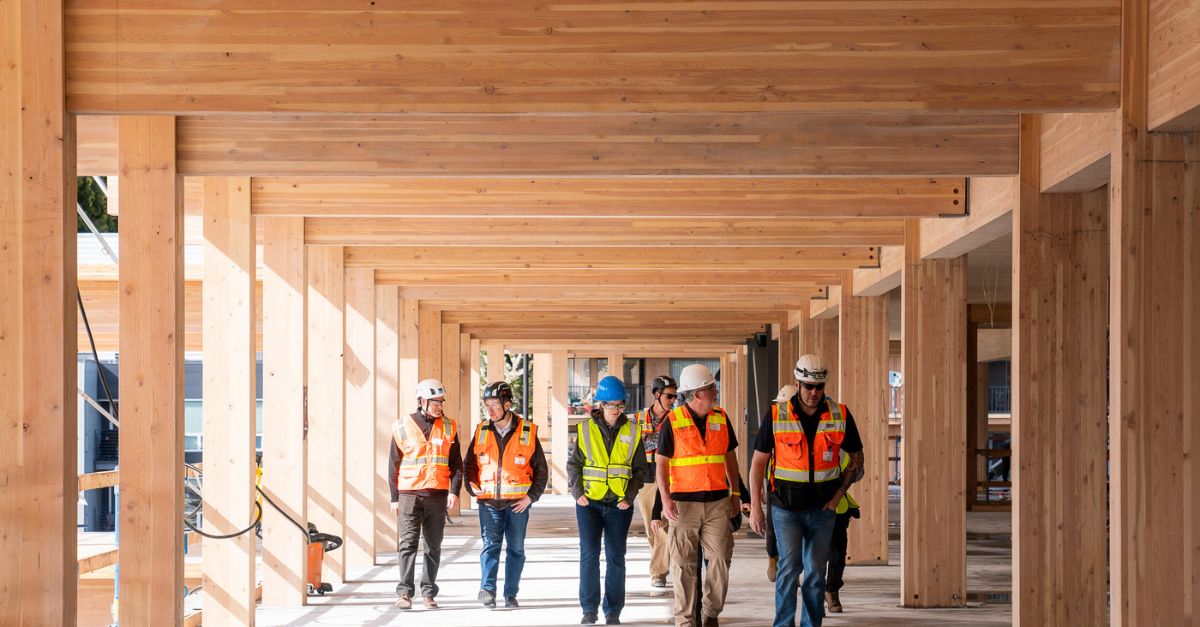
The project features stunning 91-foot-long glulam beams spanning the full gymnasium and 18-foot cantilevered beams at the main entry. These striking innovations—engineering and procuring long-span prototypes and investing in the vertical development of agile supply chains—aren’t side quests. They are essential, removing barriers and proving strategies that move the future of mass timber from early adoption to standard practice. The complexity and clear risks made these features a defining moment, one that Silva says sharpened his view of leadership.
“Innovation starts out unfamiliar—even scary. But with purpose and rigor, it becomes the new normal.”
Silva’s leadership philosophy crystallized: embrace complexity; never default to business-as-usual. He frames the work as systems coordination rather than material substitution. He holds a clear line on what determines success: the structural system, the mechanical system, and the building envelope. If those three aren’t integrated early, costs rise, schedules fail, and the promise of mass timber erodes. This is not “just another material”; it’s a catalyst that demands a different process, mindset, and cadence.
A National Market – Growing, Uneven, and Ready
A decade after Swinerton’s first mass timber project, the system is no longer an experiment in selected regions. It is a fast-maturing sector with an evolving supply chain, regulatory on-ramps, and market rhythms. But the progress is not evenly distributed.
Silva describes the U.S. as a patchwork of “regions in different stages of maturity.” Oregon remains the model, with a deep bench of successful project examples and experienced trades. Texas and the East Coast are rapidly approaching what he calls “tipping points,” where a handful of completed projects can trigger broader adoption. The future of mass timber depends on adapting to local policies, supply chains, and delivery models, not replicating a single template.
Understanding that variance, Silva says, is essential to how Swinerton x Timberlab shows up as one integrated team.
The Integrated Advantage: Building the Future of Mass Timber Together
In Silva’s telling, the real engine behind Swinerton’s national approach is the partnership with Timberlab, the mass timber affiliate formed in 2021. Swinerton brings the master builder’s skills—means, methods, and coordination across trades. Timberlab adds deep mass timber expertise across the structure and systems: detailing, delegated timber engineering, digital modeling, procurement, and installation.
Together, they close gaps that typically create risk: pricing uncertainty, coordination failures, supply chain volatility, and design-model mismatches. That, Silva argues, is where mass timber projects succeed or fail.
“Better Together” isn’t merely a tagline, he insists. It’s a delivery model.
Silva prefers outcomes to adjectives. Consider Harder Mechanical in Portland, Oregon: a two-story, 27,000-square-foot facility that Swinerton inherited after another general contractor stepped aside. The team reintegrated the mass timber structure into the design—the client’s top priority—removed $1 million through value engineering and delivered the project two months ahead of the original schedule. It’s a microcosm of the model: early integration, clear decisions, and disciplined execution.
Leadership Principles
Ask Silva what he wants new team members to absorb, and you won’t get corporate jargon; you’ll get a stance. Understand the Swinerton × Timberlab dynamic. Lead across boundaries and see yourself as a part of the broader ecosystem. Provide systemic, not surface-level solutions. And remember that mass timber only fulfills its promise when the systems—and the people—are aligned.
The View Forward: What Will Drive the Future of Mass Timber
As Silva steps into the national role, what distinguishes him is not only his technical fluency but his insistence that culture, systems thinking, and team collaboration determine whether mass timber reaches its potential. Tracing his path, from the photograph given to him by his grandmother to high-stakes project decisions, Silva offers a reminder that progress rarely comes from a single breakthrough. It comes from people willing to rethink what’s possible, align teams around a shared purpose, and lead through unfamiliarity to push conventional boundaries. Silva and the Swinerton × Timberlab team aren’t riding a trend—they’re lead characters in the next chapter of American building, the future of mass timber, one project at a time.
Looking ahead, the future of mass timber will be defined by integrated delivery, disciplined coordination, and proof at scale. With Swinerton × Timberlab leading as one team, the future of mass timber in the U.S. is shifting from niche to mainstream. Silva and Evans, longstanding partners on this continued journey, sum it up:
“We want to change the built environment. Period.”
FAQ: The Future of Mass Timber — William Silva’s Perspective
Q1. What is the future of mass timber in the U.S.?
The future of mass timber in the U.S. will be defined by integrated delivery and proof at scale. As more projects demonstrate cost certainty, schedule, and quality, owners will shift from “pilot” to “portfolio,” moving timber from niche to mainstream across multiple markets. Regional maturity will vary, but the direction is clear: integrated teams, disciplined coordination, and repeatable outcomes.
Q2. How does integrated delivery influence the future of mass timber?
Integrated delivery reduces the friction points that typically stall mass timber—price volatility, model mismatches, and trade coordination. When the general contractor and timber partner operate as one team across engineering, modeling, procurement, fabrication, and installation, owners gain certainty and a faster path from concept to completion.
Q3. Which regions are shaping the next phase of mass timber development?
Beyond early regional leaders like the Pacific Northwest, emerging “tipping point” regions include Texas and the East Coast. California remains a sleeping giant; while regulatory complexities persist, the state’s climate-driven culture is increasingly influencing policy evolution, benefiting both people and the planet. As a handful of successful projects come online in major metro areas, confidence grows, supply chains adapt, and policy pathways expand—accelerating broader adoption. Successful projects in urban areas are now leading to adoption in rural communities, delivering transformative projects sourced from domestic (and often local) renewable materials.
Q4. What convinces owners to choose mass timber again?
A great experience. If a project brings the right people with a depth of expertise and delivers predictable cost and schedule, smooth coordination, and a building people love to occupy, owners come back. The most powerful growth driver isn’t a slide deck—it’s delivering projects that make the next timber decision easy.
Q5. Is mass timber only viable if the wood is sourced locally?
Local sourcing can be part of a sustainability story, but the biggest carbon win comes from choosing timber over more carbon‑intensive materials. Transportation impacts are one small factor in a larger life‑cycle equation.
Intentional sourcing of wood fiber also offers owners and project teams a unique opportunity to let the building structure express priorities around local sourcing, tribal sourcing, or celebrating forest management practices, among other factors. In this way, mass timber structures can communicate values as well as performance.
Q6. What project types are best positioned to lead the next wave?
Education (K‑12 and higher ed), public and civic buildings, and community‑focused spaces are already leaning in. These are connecting communities to the buildings they visit and serving as spaces that create a sensory experience people are eager to share and replicate. Healthcare also fits well with timber’s human‑centered, biophilic benefits as delivery models and codes continue to evolve.
Q7. What should owners and designers do early to keep timber viable?
Every project is a complex equation of values, including place, economics (budget), and performance, among others. Resolving this equation, where each project is tailored to meet that unique configuration of values and directly communicates the intentional ‘story’ sought by owners, developers, and communities, is central to our effectiveness as partners.
Involve the general contractor and timber partner to help make an early decision but calibrate with the project team to ensure they are coming to the table as proactive partners who will enhance the outcome and “solve the equation” for project-specific challenges. If timber is considered from the first conversation—and the team aligns the structure, mechanical, electrical, and plumbing (MEP) systems, and the envelope around it—mass timber becomes cost‑competitive and easier to execute. Late swaps rarely allow mass timber to move forward; early integration does.


